Jennifer Bernstein, PhD
Editor-in-Chief, Case Studies in the Environment
Faculty, Texas Tech University
In an eight-week, online introductory environmental science course, I assigned the Wikipedia assignment in lieu of a traditional research paper. Students selected an article from a list of geoscience terms and improved it through editing and contributing text, references, and media. My learning objectives were similar to those associated with a traditional research paper: evaluating source quality, synthesizing information, writing clearly, and supporting claims with evidence. The Wikipedia assignment met these goals while also placing student work in front of a public audience.
As an instructor, I also grapple with student use of LLMs. Rather than rely on detection tools or restrictive policies, I aim to design assignments that are difficult to complete successfully using LLMs. The Wikipedia assignment does this effectively. Students also recognize that Wikipedia serves as an input for LLMs, demonstrating how information is produced and circulated.

To assess how the assignment functioned, I conducted an informal content analysis of students’ end-of-semester reflections and compared them with their final article contributions.
The most notable outcome was a change in how students understood their role in working with information. Instead of summarizing existing material, students were asked to revise, clarify, and make it usable for others. The experience was characterized less by content mastery and more by a move from receiving information to contributing to it.
Some students engaged fully with this shift and meaningfully edited their articles. These students were often more comfortable with online learning environments or more invested in the course material. For them, the assignment offered benefits beyond a traditional research paper, particularly in developing a clearer understanding of how information is constructed and disseminated.
At the same time, many students experienced the assignment as uncomfortable. Reflections expressed uncertainty about expertise and legitimacy, with students questioning whether they were qualified editors. In response, some focused on lower-risk contributions, working around the edges of their articles rather than making substantive revisions. A small number expressed strong dislike for the assignment in course evaluations.
From a pedagogical perspective, this discomfort is not surprising. Historically, students have been asked to take in information, internalize it, and demonstrate their understanding through correct answers. Over time, this reinforces the idea that knowledge is fixed and that their role is to receive it. Asking students to contribute introduces a different expectation, as it requires them to take responsibility for how information is presented and supported. This shift can feel unfamiliar, particularly in introductory or general education settings. At the same time, research on “desirable difficulties” suggests that this kind of challenge can support deeper and more durable learning (Bjork & Bjork, 2011; Bransford et al., 2000).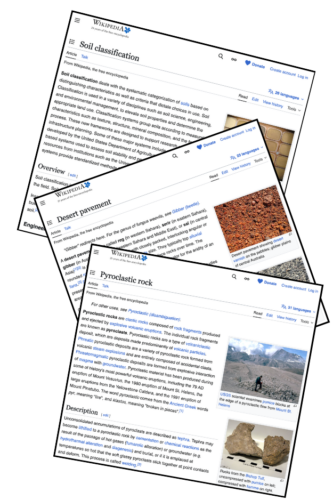
Other factors mediate how and to what degree this discomfort is experienced. Despite robust support, some students struggle with the technical demands of the platform. Others find the premise confusing, especially as many have been taught to avoid Wikipedia as a source. There is also something more fundamentally destabilizing at work. When students participate in producing and revising information, they must reconsider how it is created and trusted, and that the knowledge they encounter is the product of human construction and interpretation.
This discomfort does not lead to a single outcome. Some students step into it, engaging more deeply with the assignment and its expectations. Others hesitate or pull back, focusing on lower-risk contributions or struggling to engage. These responses are shaped by who students are and what they bring to the course. Students with prior positive experiences in online learning, stronger interest in the subject, or a sense of connection to the course community were more likely to persist through the initial uncertainty. For these students, the discomfort became productive. For others, particularly when combined with technical challenges, time constraints, or different expectations for what a course should provide, the same assignment felt confusing or misaligned. The impact of the assignment depends on how it intersects with student preparation, expectations, and course context.
Part of what makes this assignment feel different is also tied to how generative AI is reshaping the classroom and the broader information environment. Many responses to LLM use focus on restriction or monitoring. These approaches address immediate concerns but do not resolve the underlying challenge of designing learning environments that require active engagement with information. The Wikipedia assignment asks students to evaluate sources using shared standards, write for a public audience, and work within an existing body of knowledge. This is not simply a workaround for AI use. It reflects a shift toward forms of learning that prioritize evaluating information, making judgments, and working with knowledge in ways that are increasingly necessary in an AI-shaped information environment.
At the same time, this shift has pedagogical consequences. Non-traditional assignments often look and feel unfamiliar to students. They can create opportunities for deeper engagement, but they can also expose mismatches between course design and student expectations. In accelerated courses or with diverse student populations, these mismatches can be more pronounced, making careful scaffolding especially important when introducing assignments like the Wikipedia project.
For instructors considering the Wikipedia assignment, its value lies in how it asks students to engage with information as something they must work with, not simply receive. Students evaluate sources, write for a public audience, and contribute to knowledge that others will encounter. In courses with varied student backgrounds or limited time, careful scaffolding is essential to ensure that all students can engage with this work.
Even when it is uncomfortable, this kind of learning helps prepare students to evaluate information critically and make informed judgments in a landscape where those skills are increasingly necessary.
References
Bjork, R. A., & Bjork, E. L. (2011). Making things hard on yourself, but in a good way: Creating desirable difficulties to enhance learning. In M. A. Gernsbacher, R. W. Pew, L. M. Hough, & J. R. Pomerantz (Eds.), Psychology and the real world: Essays illustrating fundamental contributions to society (pp. 56–64). Worth Publishers.
Bransford, J. D., Brown, A. L., & Cocking, R. R. (Eds.). (2000). How people learn: Brain, mind, experience, and school (Expanded ed.). National Academy Press.
Wiki Education’s support for STEM courses like Jennifer Bernstein’s is available thanks to the Guru Krupa Foundation.
Interested in incorporating a Wikipedia assignment into your course? Visit teach.wikiedu.org to learn more about the free resources, digital tools, and staff support that Wiki Education offers to postsecondary instructors in the United States and Canada.