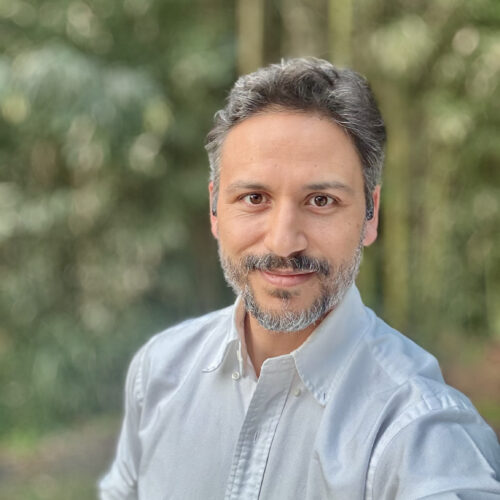
By Francisco Laso, Ph.D. Environmental Studies, Western Washington University
A student once stopped me after class and said, flatly: “You know your class is deeply depressing, right?”
He wasn’t wrong. I teach Extractivism and Its Alternatives in Latin America, a four-credit course that examines what happens when an economic system is built on removing natural resources from one part of the world (oil, minerals, soy, fish) and exporting them somewhere else, where most of the value is captured and most of the harm stays behind. I watch Environmental Studies students hold their heads as we work through the social, environmental, and economic consequences of this system. The subject is vast, the timeline is long, and the damage is real.
So student morale is something I think about. Seriously.
That’s actually how I found Wikipedia. My first instinct, when I wanted to give students a sense that their work could matter beyond our classroom, was to have them write a literature review about a resource and a region of their choice, formatted for Occam’s Razor, Western Washington University’s undergraduate research journal. I spent real time teaching proper citation, source evaluation, and academic voice. I was proud of what students produced. I told them, at the end of the quarter: submit it! You’ve put in so much work, it’s likely to get in.
When I ran into one of those students the following quarter and asked how the submission went, she told me all the essays had been rejected. Too many submissions on similar topics, the editors said.
I needed a different outlet. Something that would give students a genuine sense of contribution, that their research would actually reach someone, somewhere, and make a small difference. That’s when I came across Wiki Education, and I was immediately drawn to the premise: students contributing to open-access, public knowledge production. The democratic ideal of the internet. That was my only intention.
What I didn’t expect was what the assignment would do to the quality of their thinking.
Students learned not all sources are created equal
When students begin the course and I ask them to find sources, many reach for what they know: websites, advocacy blogs, NGO reports. They may never have learned what a peer-reviewed source is, or why it’s different from other things they find online. Teaching them to navigate scientific literature (to read widely, to build an annotated bibliography, to use reference management software like Zotero) had always been part of my course. But the Wikipedia assignment raised the stakes in a way that no assignment rubric ever quite could.
Wikipedia’s own editorial standards did the work for me.
The platform requires that every sentence be attributable to a reliable, verifiable source. Not a blog. Not an advocacy website. A source that can withstand scrutiny from any editor, anywhere in the world, at any time. Students learned this not as an abstract rule but as a lived consequence: unsourced or poorly sourced sentences get flagged, challenged, or removed. The annotated bibliographies I received after introducing the Wikipedia assignment were noticeably stronger: more numerous, more peer-reviewed, and more diverse, including sources from Latin American scholars and institutions that students would not have encountered if they had simply Googled their topic.
This last point matters especially for a course about the Global South: elevating underrepresented perspectives in a public digital space is itself a small act of the epistemic justice we discuss in class.
Students learned less is more
Before I used the Wikipedia assignment, students wrote final research papers. Long ones. And I noticed a persistent problem: length was treated as a proxy for quality. Essays were often verbose, rambling, and diluted, burying whatever was genuinely valuable beneath pages of words that added no meaning. I kept telling students: it’s not about word count, it’s about the quality of every sentence. They nodded. The papers didn’t change much.
Wikipedia changed it.
The platform has two requirements that together solved this problem. First, the citation-per-sentence standard: every claim must be grounded in a source. This forces economy of language. You cannot write a sentence you cannot substantiate. Second, and perhaps more surprisingly: Wikipedia requires a neutral point of view. Students are not permitted to share their own opinions. They cannot editorialize. They can only paraphrase what their sources say, accurately, precisely, and without embellishment.
For students in a course about urgent, emotional topics like environmental destruction and Indigenous dispossession, this was genuinely hard. But it was also exactly the discipline I had been trying to teach. “Show, don’t tell” became concrete. The actual Wikipedia edits students produced were often small and focused, but the research infrastructure behind each sentence was enormous.
Students learned writing is thinking
On the first day of class, I tell students that we will not use AI for writing, not because AI isn’t useful, but because writing is part of the thinking process. You don’t know what you think until you’ve had to put it into words, wrestle with structure, and make an argument hold together. Students nod at this, too.
Then, about midway through the quarter, something happened that illustrated my point more vividly than I ever could have. One student used AI-generated text in their Wikipedia sandbox draft. Wiki Education’s systems flagged it automatically. It hadn’t gone live on a public page, but the effect on the class was palpable. Students suddenly understood, viscerally, why the standard existed. They became more careful, more deliberate, more invested in the authenticity of their own prose. The anxiety of having their work taken down by an anonymous Wikipedia editor (which several students mentioned in their reflection journals) turned out to be a powerful motivator for rigor.
Students learned to work together
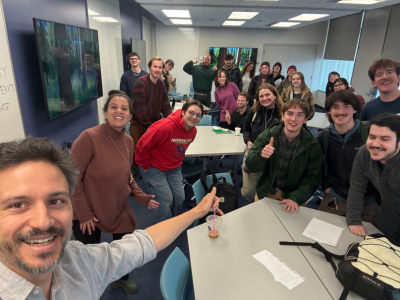
I’ve taught this assignment twice now: once in Fall 2024 with a seminar of 15 students, and again in Winter 2026 with 29. The main change I made in the second iteration was grouping students into pairs based on shared interests, with each pair responsible for editing one article (or two closely related ones).
My initial concern was traceability: how would I know who contributed what? Wiki Education’s built-in contribution tracking resolved this. Individual edits are logged and attributable, so assessment remained fair and individual even within the collaborative structure. But the more important discovery was intellectual: pairs became expert communities. Students who were researching, say, agrarian conflicts in the southern cone were the most qualified people in the room to push back on each other’s sources, identify gaps, and keep each other honest. In one group of three, students who had gone down the relatively specialized path of mining law in Latin America, the mutual support they provided each other was something I, as a non-lawyer, genuinely could not have offered.
Students took this learning beyond the classroom
I came to Wikipedia for the morale problem. A subject this heavy, in a ten-week quarter, can leave students feeling overwhelmed and helpless. I wanted them to feel that their work reached beyond our classroom. That part worked, and I’m grateful for it. But I’ve also come to expect something more from this assignment: a kind of intellectual confidence that stays with students after the quarter ends. Again and again, students have told me that the rigor of the class gave them the tools to explore deep and complex subjects on their own, and that this was something they would carry with them well beyond the course.
One student captured it in her final reflection journal: this was “easily one of my favorite classes I’ve taken, if not my favorite,” she wrote, that it had been “challenging, both academically and emotionally,” and that she had been talking to her parents and friends about what she’d learned, recommending documentaries, wishing she had “arranged her schedule to focus more on this class.”
That’s learning. And I am convinced the Wikipedia assignment had something to do with it.
Some advice if you are considering it:
If you’ve read this far and you’re still on the fence about adding a Wikipedia assignment to your course, here’s what I’d tell you:
Make it a centerpiece, not an add-on. The assignment works because it’s woven throughout the quarter: the annotated bibliography, the source training, the drafting, the peer review. A Wikipedia edit tacked onto the end of a course won’t produce the same results.
Let Wiki Education carry the technical weight. Their training modules handle the platform learning curve. You don’t need to become a Wikipedia expert. Their staff are also genuinely supportive, for you and for your students.
Bring in the library. I taught the Wikipedia assignment alongside library sessions on navigating scientific literature, reading peer-reviewed articles, and using Zotero. The annotated bibliography is the heart of the project, and students need scaffolding to build it well.
Warn students early that it will involve a lot of reading. They will complain. They will also rise to it, especially when they understand that they’re contributing to a public resource that anyone in the world can read.
My students came into this course expecting to write papers. They left having contributed to the public record on topics that matter. They learned that good writing isn’t about length, it’s about every sentence earning its place. They learned to identify high-quality sources and use them to conduct inquiries with their peers. And they learned, maybe for the first time, that having an opinion and being able to prove it are two very different things.
That’s not nothing. In a course about a subject this heavy, it really helped carry the weight.
Francisco Laso is an Assistant Professor in the Environmental Studies Department at Western Washington University, where he teaches ENVS 334: Extractivism and Its Alternatives in Latin America and other equally rigorous but hopefully less depressing courses.
Many thanks to the Guru Krupa Foundation for supporting students to improve STEM content on Wikipedia!
Interested in incorporating a Wikipedia assignment into your course? Visit teach.wikiedu.org to learn more about the free suite of support and staff guidance that Wiki Education offers to postsecondary instructors in the United States and Canada.