Teaching with Wikipedia for the first time can be a daunting prospect. Adopting any new pedagogical endeavor takes time, planning, and careful thought, and the Wikipedia assignment has the added complexity of a public-facing project. Wiki Education regularly turns to its incredible returning faculty to provide firsthand advice to new faculty considering running a Wikipedia assignment, but often these individuals have been teaching with Wikipedia for many years. Their experience and expertise are invaluable to our program, but their long tenure with the program means that they may not quite remember what it was like to do the project for the first time.
And that’s why in March, we hosted a Speaker Series webinar to feature faculty who taught with Wikipedia for the first time in the fall term, giving us the opportunity to capture and share their firsthand perspectives while their experiences were fresh.
Several of our panelists explained that they decided to adopt the Wikipedia assignment because of its far-reaching impact. As Jennifer Bernstein of Texas Tech University put it, “Microsoft Word is where ideas go to die.” Unlike a traditional writing assignment, student contributions to Wikipedia have the potential to be read by millions and more than that, their work lives on beyond the class.
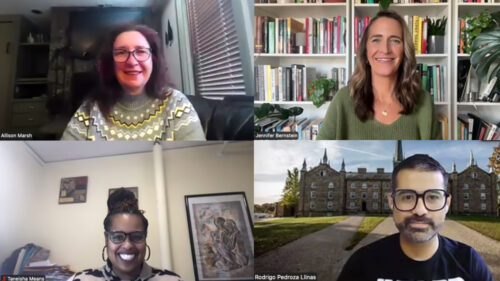
We often refer to the Wikipedia assignment as an open pedagogical resource. This isn’t simply because students are engaging in the construction of openly accessible knowledge, but because the Wikipedia editing community itself takes on a pedagogical role. While speaking about the Wikipedia assignment and AI, Allison Marsh of the University of South Carolina remarked that when her students get feedback from the Wikipedia community, the lessons she’s trying to impart hit home in a way that she alone cannot achieve. There’s an extra layer of accountability baked into the Wikipedia assignment that both motivates students and reinforces learning outcomes.
While the public-facing nature of the project serves to inspire many students, it can also engender anxiety, something several faculty on the panel had to grapple with as they introduced the project to their students.
To address any nerves, Rodrigo Pedroza Llinas of Kenyon College assured his students that this was the first time he was learning to edit Wikipedia as well, and that they would all learn together. In fact, this is a common refrain among faculty — that they learn alongside their students, creating an atmosphere of collegiality and mentorship in their class.
While some students may feel anxious about contributing to Wikipedia, Dr. Bernstein offered a different perspective.
“One thing that really attracted me was that it was an inspiration,” said Bernstein. “It was a positive story that I could tell students. I feel that students feel like they’re drowning in information, information inaccuracy, they’re barraged by AI, anxiety, and searching for truth. In this assignment, they’re interacting in a safe, supportive, collaborative space that through working together, we make information better rather than worse.”
In an increasingly unstable information landscape, Wikipedia may offer students solid footing and reassurance that they can play a positive role in crafting and sharing knowledge.
The panelists readily acknowledged the challenges of teaching with Wikipedia for the first time, but remarked on how well-supported they were by Wiki Education. “The dashboard has this great little button that says ‘Get Help’,” explained Marsh. “If you hit that button, someone from Wiki Education’s staff will get back to you amazingly quickly to answer your questions.”
In addition to Wiki Education’s support, Dr. Taneisha Means of Vassar College offered other strategies that proved helpful, such as multiple rounds of peer review and having her students meet with a social science librarian to help them as they began their research. Dr. Pedroza Llinas mentioned that he built in regularly scheduled time to meet with his students about the Wikipedia assignment to quickly head off any issues as they arose.
And the Wikipedia assignment not only benefits students, but has positive outcomes for faculty as well.
“I would say for me as a person who studies democracy and representation and thinks about political inequality, I’m really excited always for my students to introduce me to new people, policies, and historical moments,” remarked Means.
Faculty often comment on how grading the Wikipedia assignment is more enjoyable and that they too learn new concepts and ideas as their students delve into their contributions.
If you’re thinking of running a Wikipedia assignment for the first time, consider Bernstein’s reflection:
“It’s really well scaffolded, the Wiki Education team is incredible, and it’s really flexible,” said Bernstein. “It can be scaled to face-to-face, online, asynchronous, synchronous, and different learner levels. I would just say there’s a lot of ways and options to easily modify it using the interface that’s already there to serve your needs.”
Thank you again to our amazing March webinar panelists. We look forward to welcoming more faculty to the Wiki Education community next term!
Join our next Speaker Series webinar tomorrow, April 15!
Earth Day, Every Day: Preserving Biodiversity on Wikipedia
Wednesday, April 15, 2026
11 am Pacific / 2 pm Eastern
Zoom Registration
Interested in incorporating a Wikipedia assignment into your course? Visit teach.wikiedu.org to learn more about the free resources, digital tools, and staff support that Wiki Education offers to postsecondary instructors in the United States and Canada.