Earth Day may come just once per year, but the work to better understand, protect, and celebrate biodiversity by contributing to Wikipedia never stops.
When information about a genus of fig wasp exists only in paywalled journals or obscure publications, its incredible ecological importance, and even its existence, can remain largely unseen. But by developing and expanding Wikipedia articles on underrepresented species, ecosystems and habitats, ecological relationships, and other biodiversity topics through their Wikipedia assignments, university students are helping to create freely accessible starting points for public understanding, research needs, and conservation efforts.
Last month’s Speaker Series webinar, “Earth Day, Every Day”, brought together a panel of faculty who teach with the Wikipedia assignment and Wiki Education’s Senior Wikipedia Expert to explore this ongoing work to improve Wikipedia’s coverage of biodiversity topics and to consider its wider impact.
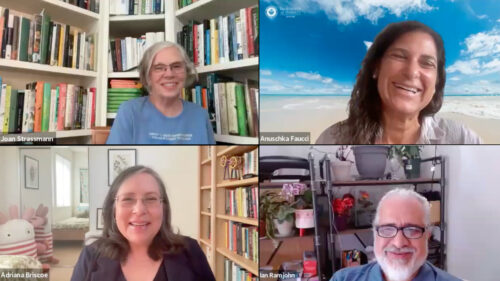
“What’s on Wikipedia affects what gets researched, what gets attention,” explained Wiki Education’s Ian Ramjohn, who has supported student editors for nearly 12 years and has contributed to biodiversity topics on Wikipedia for more than two decades. “It’s been shown that the information that’s on Wikipedia affects not just the way things are discussed in the primary literature, but even the language used.”
Like Ramjohn, panelist Joan Strassmann also brought her deep experience with the free encyclopedia and its student contributors to discussion. The Washington University in St. Louis professor has run Wikipedia assignments in her biology courses for more than a decade, and the cumulative reach of her students’ work (more than 60 million pageviews!) reflects just how much that sustained commitment can add up over time.
“I just decided I teach really smart kids at these fancy elite schools, and their work should give back to the community and not end up in a drawer,” said Strassmann of her original motivation to incorporate the project.
And when students put their work into the world, they may encounter something a traditional assignment can’t offer, she noted.
“It’s been very empowering to see them get criticized, not by me, but by the world,” said Strassmann.
With a staggering 26 Wikipedia assignments under her belt, marine biologist Anuschka Faucci of the University of Hawaii’s Leeward Community College was also quick to emphasize what it means for student work to reach a public audience and be reviewed by other Wikipedia editors.
“I get the emails [from my students], ‘My [text] disappeared, I promise I did it!’” said Faucci. “Then there’s the whole discussion of why it wasn’t good enough for [Wikipedia’s] standards, and that’s definitely a huge eye-opening learning experience.”
While the editing project deepens students’ connections to her course material, Faucci also underscored the skills they develop beyond the subject matter itself.
“Students these days mostly learn how to say very little in many sentences,” said Faucci. “Wikipedia teaches them to cut down the fluff, and that’s the base of scientific writing.”
For University of California, Irvine’s Adriana Briscoe, the Wikipedia assignment opens doors to conversations about the research process and source evaluation.
“Many of them don’t have experience looking things up,” said Briscoe, who studies butterfly evolutionary ecology. “I love this assignment because it allows me to talk about so many things, like bibliographic databases. I asked them last week, ‘Have you heard of PubMed, or Web of Science, or even Google Scholar?’ Basically nobody in the room had heard of these tools. It’s the intersection of knowledge building and skill building that makes me extremely excited [about the assignment].”
There’s no doubt that a designated Earth Day draws our collective attention to the natural world, but the work to make it more visible and understood can’t wait. Thanks to the efforts of student editors and thousands of Wikipedia contributors beyond, it’s happening every day — one article at a time.
Missed our “Earth Day, Every Day” webinar? Access the recordings for all previous Wiki Education Speaker Series webinars here.
Interested in incorporating a Wikipedia assignment into your course? Visit teach.wikiedu.org to learn more about the free resources, digital tools, and staff support that Wiki Education offers to postsecondary instructors in the United States and Canada.