Christina Carney is an associate professor in the Department of Women’s and Gender Studies at the University of Missouri (Columbia) and an ASALH Book Prize Finalist (2026).
My students’ participation with Wiki Education’s Wikipedia Assignment has enabled more people to have access to research on black sexuality and intersectionality. This is significant because discussions about sexuality and sex are still taboo in departments like Black Studies. Yet students are not shy at all when it comes to talking about histories of violence, how they play out in contemporary societies, and how black people find ways to create pleasure and joy amidst anti-black gendered violence. Within seven semesters, my students have updated 103 Wikipedia articles (and created 27 new Wikipedia articles) which have amassed over 3 million views (and counting).
During the first week of class, we position Stacey Patton’s provocative essay, “Who’s Afraid of Black Sexuality?” in The Chronicle of Higher Education, as a starting point for thinking through how silence about sex and pleasure has “left a gap in the classroom and in black studies scholarship.” While prominent black feminist scholars have illuminated histories of black women’s sexual violation under slavery and their counter-resistance, the culture of dissemblance in black communities to shield themselves from racism, and sexual ideologies that fueled Jim Crow legislation and lynching – few have said anything about “black sexual agency, pleasure and intimacy, or same-sex relationships.” Instead, black sexuality is still exclusively positioned in relation to white violation, dehumanization and the larger project of positioning black folks as subhuman. While this gap has been undertaken in the fields of black (queer) studies (E. Patrick Johnson, Robert Reid Pharr, Cathy Cohen) and queer of color critique (Roderick Ferguson) new scholarship in black sexuality studies suggests that “although the dynamics of respectability have evolved they are not any less insidious (466, Collins).
Students are excited to update Wikipedia with knowledge that challenges gender and sexual normativity. One of my favorite page updates is Players Magazine – an erotic magazine (founded in 1973) that was popularly referred to as “the black playboy.” The magazine was important because for the first time it featured US black Americans as sexual subjects with agency – unlike other softcore men’s magazines of the day that rarely featured a black model or when they did it was drenched with racist stereotypical portrayals of black women and men (i.e. slave, housemaid, etc.). Even more, Players included articles about black politics and art which is useful in understanding how young black people in the Vietnam War era, for example, were articulating their own views on sex and sexuality. Students first learned about Players while reading Mireille Miller-Young’s A Taste for Brown Sugar: Black Women in Pornography (2014) in the Black Sexual Politics course. They used Miller-Young’s insights to update the page with a discussion about colorism and the ongoing conversation about race and representation. Another fun page was Raunch aesthetics – using Jillian Hernandez’s Aesthetics of Excess: The Art and Politics of Black and Latina Embodiment (2020) students applied Hernandez’s theory in their discussions about Lizzo, Megan Thee Stallion and Chlöe Bailey.
I found that students would often take initiative in “raising the bar” by creating new pages which meant that they had to not only engage the assigned readings but use library databases/Google Scholar and primary documents. A perfect example of this is the Rogers v. American Airlines (1981) Wikipedia article which was created by a student group in the Spring 2022 Understanding Intersectionality class. The article begins with the facts — how a black woman American Airlines flight attendant sued her employer for sex and gender discrimination (a hallmark of intersectionality theory). In the next section, students summarized academic discourse about the topic which highlighted the need for the scholarship of Kimberlé Crenshaw, legal scholar and black feminist who coined the term “intersectionality.” Students ended the section with the Crown Act, a California law prohibiting discrimination based on black hairstyles. The page offered accessible language that demonstrated how the Rogers (1981) case was indebted to black feminist intersectional theory and how it influenced public policy.
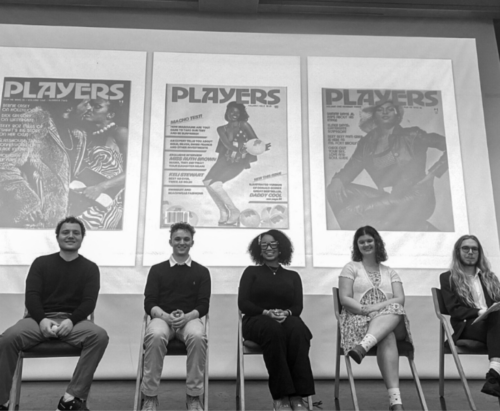
To my surprise, students continued to study these topics after they completed my course – and some even did public research presentations. In the photo (above) are two of my students (Journalism majors) who presented at the MU Center for Humanities Undergraduate Research Symposium. Savvy Sleever presented on the Rogers v. American Airlines (1981) court case and Aysia Grey discussed her research on Players Magazine.
The students’ contributions influenced me to update and create my own Wikipedia articles. During my fifth semester running the Wikipedia Assignment with support from Wiki Education, I updated the Mann Act and created United States v. Ingalls (1947). Wiki Education’s program does not mandate that instructors edit articles alongside their students, but I think it is important for instructors to do so because not only are you able to help your students navigate the program, but then you (as an instructor) are able to concretely grasp the importance of the program.
As a scholar of critical trafficking studies, I realized that there were content gaps that I wanted to address. In the popular imaginary Jack Johnson (1878-1946), defamed black boxer, is often noted as being the first person to be prosecuted using the Mann Act – a progressive era federal policy that essentially made prostitution (and non-marital sex) a federal offense. However, I corrected the timeline on the page to include the prosecution of Bella Moore, who was convicted three years prior to Johnson. This is significant because women were the primary victims of this criminalization – not men. Ingalls is a case that many people do not know about – and that’s exactly why I wanted to make this page! Mira Elizabeth Ingalls, a white woman, was convicted of enslaving and trafficking Dora Jones – a black woman. The case is significant because it was the first time a federal prosecutor used the 13th Amendment (amendment which prohibited slavery and involuntary servitude except as a punishment for a crime) in the 20th century. These entries made me appreciate Wikipedia in ways that would not be possible had I not been a Wikipedia contributor.
Spring 2027 will be my eighth semester teaching with the Wikipedia Assignment. The stakes have changed since I first started in 2018. AI has solidified why it is important, now more than ever, that students understand why human-authored writing is valuable. We are also witnessing book bans and the closure of Black Studies and Latinx departments across the country. Our current political moment should compel us to create and foster spaces where ideas are not policed or censored. “Who’s Afraid of Black Sexuality?” Not Wikipedia!
Citations
Patton, Stacey. “Who’s Afraid of Black Sexuality?” The Chronicle of Higher Education, December 3, 2012. https://www.chronicle.com/article/whos-afraid-of-black-sexuality/.
Collins-White, Mali D., Ariane Cruz, Jillian Hernandez, Xavier Livermon, Kaila Story, and Jennifer Nash. “Disruptions in Respectability: A Roundtable Discussion.” Souls: A Critical Journal of Black Politics, Culture, and Society 18, nos. 2–4 (2016): 463–75.
Interested in incorporating a Wikipedia Assignment into your course? Visit teach.wikiedu.org to learn more about the free resources, digital tools, and staff support that Wiki Education offers to postsecondary instructors in the United States and Canada.