In 2016, Wiki Education dropped a pebble in the waters of science content on Wikipedia with our Year of Science initiative. The ripples from that pebble grew into our Communicating Science Initiative, and over the last ten years we have supported over 70,000 students and scholars in improving almost 70,000 Wikipedia articles and adding 635,000 references to STEM content.
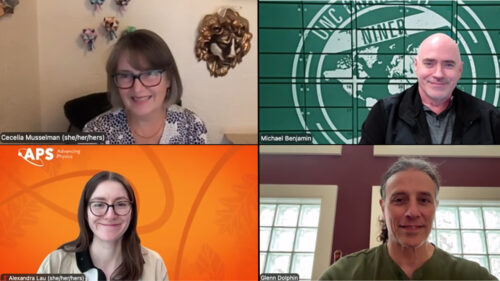
On October 8, the Wiki Education Speaker Series celebrated those achievements. The conversation included four veterans of our programs — Cecelia Musselman, Teaching Professor at Northeastern University, Michael Benjamin, Teaching Professor at the University of North Carolina at Charlotte, Glenn Dolphin, Associate Professor at the University of Calgary, and Alexandra Lau, Senior Program Manager at the American Physical Society — and was hosted by Ian Ramjohn, Wiki Education’s Senior Wikipedia Expert.
High-quality sources are the backbone on which all good Wikipedia content is built, and was what drew Cecelia Musselman to the Wikipedia assignment. Musselman teaches advanced writing for the sciences, a graduation requirement for science majors. When she first began teaching the course, she struggled to get her students to understand the idea of a reference article.
In a passing conversation with her director, Musselman mentioned that “the only encyclopedia they know is Wikipedia”, to which he replied “have them write Wikipedia articles”. Musselman took that idea and ran with it, and created a Wikipedia assignment for her writing class. After doing a “rogue” Wikipedia assignment for several years, she discovered Wiki Education shortly before we launched the Year of Science. Fifty-five classes later (including three in progress this fall), Musselman has brought 862 students to Wikipedia who’ve improved over 1,100 articles and added over 9,300 references.
“One of the really profound impacts on my students has been [that] they take citation really seriously. It doesn’t matter what else I do with them, it’s not until we get to the Wikipedia part of the semester when they start getting really serious about sources and source quality and where they come from,” Musselman observed.
While the main focus of the Communicating Science Initiative has been in the Wikipedia Student Program, participants in our Scholars & Scientists program have also made significant contributions to science content over the years. Much of this work has come through a partnership between Wiki Education and the American Physical Society, which sponsors Wiki Scientists courses. These courses primarily bring graduate students and early career researchers to Wikipedia to work in their area of expertise.
When speaking about the impacts of APS members on the encyclopedia, Alexandra Lau struck a similar chord as Musselman. “Verifiability is a key pillar of Wikipedia…and one of the things that I think makes me particularly proud is seeing the references that are added, bringing the connection to the scientific literature…and so making sure that it’s more accessible and available, feels really important…I always like to see how many references are added by our editors.”
Communicating Science isn’t just about improving science articles, it’s also about improving articles about scientists, especially those from historically excluded groups.
“When I first started the Wikipedia project, I had met a professor from the West Coast, and she had a list of women geologists. There were 150 women on this list,” recounted Glenn Dolphin. He explained that when the professor learned that he was doing a Wikipedia project focussed on women geologists, she passed the list on to him.
“Probably 5 years after I had started this project, “Dolphin continued, “she wrote me an email, and she said, I’ve taught this geology course for the first time in a couple of years, and when I went to look at this list, I noticed that there are so many more women geologists on Wikipedia now.”
Wikipedia, of course, isn’t just in English. There are active Wikipedia projects in 348 languages. And these different language Wikipedias aren’t simply translations of the articles on the English Wikipedia, although translation can help fill gaps in different language versions.
In Michael Benjamin’s classes, translation has opened a door for his students. “We have a lot of international students, and one option that I’ve given the international students is that if they want to translate an article into their first language, they can. I think we’ve had a lot of motivation for the students to do that, because there might not have ever been an article about that topic in their first language.”
And as Benjamin’s classes have learned, there’s also scope for translating articles into English. “The last time a student of mine was working on something like this, we found out that in geometry, the Mandarin Wikipedia has incredible coverage in various places that simply doesn’t exist in English.”
Not every contribution to Wikipedia needs to be big to make a difference. Sometimes just changing a few words can have a major impact. Students in any given class or setting can bring unique perspectives to topics based on their education and experience.
Benjamin observed, “Sometimes my students think that they have to recreate everything, or redo everything…[but] sometimes, if you’re gradually improving that article, it’ll make a difference in the end. It might [just] be uploading a picture.”
From students, to early career scientists, to the occasional Nobel laureate, our Communicating Science participants bring a unique set of skills to Wikipedia.
Both Wikipedia and the world have changed a lot since 2016. Back then no one had heard of COVID-19 or ChatGPT, and few would have imagined the impacts that mRNA vaccines and CRISPR gene editing would have on science and medicine. New discoveries in STEM will always need to be added to Wikipedia, like the tilcayo, the first new living cat species discovered since 1923, while the contributions of excluded or overlooked scientists will continue to modify our understanding of how science has progressed.
Despite all the contributions of both students and the amazing work of the volunteer community, a decade after the Year of Science, Wikipedia continues to need more and better STEM content. Your contributions and those of your students are always needed.
Wiki Education’s Speaker Series is a monthly, Zoom-based panel discussion that brings together experts in Wikipedia and open knowledge to examine topics relevant to our communities. Each session is moderated by a Wiki Education staff member, includes a live audience Q&A, and is recorded for Wiki Education’s YouTube channel.
Visit our website to learn more and receive our next Speaker Series invitation.
Learn more about teaching with Wikipedia at teach.wikiedu.org, or explore editing yourself at learn.wikiedu.org.