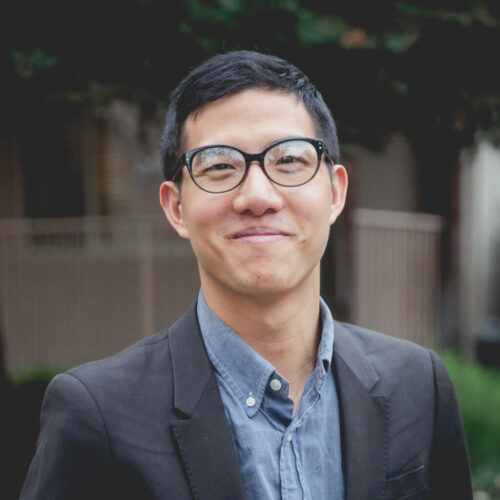
Ray Pun is the academic and research librarian at the Alder Graduate School of Education and a past participant of the Committee of 100’s Next Generation of Leaders program.
Being selected for the inaugural Committee of 100’s Wikipedia Fellowship program was a great opportunity to collaborate with other community members to make Asian American stories publicly available and contribute to public knowledge at large. The Committee of 100 is a 501(c)(3) nonprofit organization whose goal is to “encourage constructive relations between peoples of the United States and Greater China.”
This fellowship program enabled 25 members to participate in an online Wikipedia editing course hosted by Wiki Education. Over eight weeks in the fall, we met weekly and developed and expanded various Wikipedia entries focused on Asian American history, particularly on Chinese American figures and institutions. As a librarian who has collaborated with educators and community members to promote Wikipedia as a learning platform inside and outside of classrooms, I saw this course as an opportunity to refresh my learning in a community of practice. I’ve organized Wikipedia editathons for the Asian Pacific American Librarians Association and the Chinese American Librarians Association, and participated in Art+Feminism Wikipedia events in the past. These activities inspired me to co-edit an open-access book (along with librarians Laurie M. Bridges and Roberto Arteaga) titled Wikipedia and Academic Libraries: A Global Project in 2021.
For the Committee of 100’s Wikipedia Fellowship program, each fellow created or edited one to two entries; including Henry W. Low, the first Chinese American judge in the San Francisco Bay Area, and Virginia Wing, a Chinese American actress, singer, and writer. I specifically wanted to focus on education and educators while participating in this program, and worked on Save Cantonese, a nonprofit organization dedicated to preserving and promoting the Cantonese language and culture in the United States. As a child of immigrant parents who grew up speaking Cantonese, I have an affinity for the language itself. I knew about the Save Cantonese campaigns promoted on social media and in various institutions, but given the increasing interest in Mandarin, I wasn’t surprised to find that it didn’t have its own Wikipedia article.
According to Wikipedia, Mandarin has over 1.18-1.2 billion speakers, while Cantonese has approximately 80-86 million speakers. The usage of Cantonese has shrunk over the years due to new policies and practices. It felt important to create an entry for this organization, which advocates for Cantonese and is mostly volunteer-run, specifically by and for students.
Going through many digital sources to cite and to support what Save Cantonese was doing was a familiar experience for me, as a librarian. Reading how this campaign has impacted local communities across California was very eye-opening. For example, at the University of California, Los Angeles (UCLA), students collaborated to promote the reinstatement of Cantonese classes; they shared a deep passion for learning the language and, most importantly, to reconnect with their heritage. I don’t think I would have spent time reading these articles if it weren’t for this program, so now I have a deeper appreciation for language advocacy work and language movements in general.
One familiar problem I encountered is that many digital sources are behind paywalls, making them difficult to access and cite appropriately. What I also find challenging and interesting is that sometimes there may be artificial intelligence-generated sources on other websites that highlight this organization or its campaigns; these sources are not real. Wikipedia has its own rules for using AI tools, but I believe there will be more and more hallucinated citations if journalists, writers, and web editors do not verify citations before adding them to websites or news articles as a credible source.
During the course, our instructor, Will Kent, did a spectacular job answering many questions, from uploading images to moving the new page from the sandbox to publication. We learned a lot each week, and I was inspired by my peers to see the work that they created. This is my first time creating a new entry; I have edited many Wikipedia articles in the past, but never felt I had time to create one. Will provided useful feedback for each of our contributions. Once the article was published, other Wikipedia editors contributed additional content and sources. This is the part where creators will feel a sense of community as they support each other. I later saw the Wikipedia article that I created mentioned and discussed in a Reddit Thread. I am appreciative of the Committee of 100 for this opportunity, my cohort peers for being a great sounding board, and Will Kent for his detailed instruction and engagement with us. I highly recommend that everyone (experienced or not) participate in Wiki Education’s editing courses, as they offer an opportunity to contribute and engage with public knowledge, especially highlighting people or organizations that have been erased, neglected, forgotten, marginalized, or left out.
Interested in learning how to add your expertise to Wikipedia? Explore Wiki Education’s upcoming editing courses.