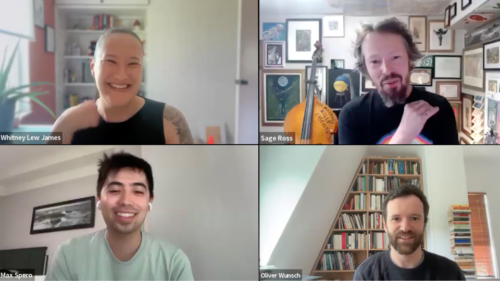
On September 2, more than 300 attendees joined the latest edition of Wiki Education’s Speaker Series, which returned to a subject it first explored in August 2025: Wikipedia in the age of generative AI. Moderated by Chief Programs Officer LiAnna Davis, the panel included Sage Ross, Wiki Education’s Chief Technology Officer and a longtime Wikipedia editor; Max Spero, CEO and co-founder of AI-detection company Pangram Labs; Oliver Wunsch, who teaches art history at Boston College; and Whitney Lew James, who teaches first-year writing at the University of Notre Dame.
AI erodes the signals editors rely on
Sage opened by identifying the most significant change to Wikipedia in the era of generative AI: an erosion of trust. Editors have traditionally assessed contributors by whether their writing is coherent and reflects familiarity with the subject.
“AI just does such a good job at making plausible text,” Sage said. “It really breaks down those signals that Wikipedia editors rely on to know how much trust to put in another person’s writing.”
AI also lowers the cost of manipulation, he added. Writing in Wikipedia’s neutral, encyclopedic tone once required real effort from those seeking to promote a person, product, or cause; AI removes that barrier and, as Sage noted, “lets you do things at a much higher scale.” Because chatbots incorporate new Wikipedia edits quickly, even obscure articles have become targets.
Verifiability is where AI breaks down
A consistent weakness surfaced across the panel: AI-generated text rarely corresponds to its citations. Sage explained that current models can produce accurate facts and suggest relevant sources, but linking a specific claim to a specific source “is where AI usually completely breaks down.”
Oliver has observed the same pattern in his courses.
“Without exception, [with] the text that has been flagged as AI generated through this Pangram integration, I’m always able to find some way in which the text fails the verifiability standard,” he said. He added that chatbots favor freely available online sources over authoritative books and paywalled scholarship.
Detection as a starting point, not a verdict
Max explained how Pangram’s classifier distinguishes human writing from AI-generated text. Sage described the evaluation that led Wiki Education to adopt the tool: running years of past student work through it. The results, he said, showed “zero hits from before late 2022 when ChatGPT launched.”
Even so, instructors treat a flag as the start of a conversation rather than a conclusion. Asked how she handles flagged work, Whitney said, “In short, I would say very carefully.” Some flags have traced back to AI-generated text already present in the Wikipedia articles her students were editing, which she uses to illustrate why the policy matters.
Lessons that reach beyond Wikipedia
Both instructors have found that discussions of AI enrich their broader curricula. Oliver’s students have drawn parallels between the arrival of AI and the invention of photography, and have examined what makes a painting such as Washington Crossing the Delaware appear trustworthy. The lesson, as he described it, is that an authoritative style is not evidence of accuracy: “You actually have to cross-reference with sources.”
For Whitney, the Wikipedia assignment conveyed the importance of citation more effectively than the traditional literature review it replaced, in part because students recognized how widely their work would circulate.
“This isn’t just writing an essay for me as your teacher,” she said.
A call to action
Asked to name one step instructors and editors can take to protect information integrity online, Whitney answered directly: “Contribute to Wikipedia.” Other panelists emphasized transparency about AI use, with Max cautioning that without proper disclosure, “we could enter this culture of much greater distrust.”
Join our next discussion
Wiki Education’s Speaker Series is a monthly, Zoom-based panel discussion that brings together experts in Wikipedia and open knowledge to examine topics relevant to our communities. Each session is moderated by a Wiki Education staff member, includes a live audience Q&A, and is recorded for Wiki Education’s YouTube channel.
The conversation continues this week! The October edition of the Speaker Series is free and open to anyone interested in Wikipedia, open knowledge, and the integrity of public information:
Communicating Science on Wikipedia
Thursday, October 8, 2026
1 pm Pacific / 4 pm Eastern
Zoom Registration
Learn more about teaching with Wikipedia at teach.wikiedu.org, or explore editing yourself at learn.wikiedu.org.