When you think of Mayan languages, hip-hop music may not be the first thing that comes to mind. The modern music genre wasn’t on Eve d’Evegnee’s radar either, until she and her classmate found it when searching for scholarly articles on Guatemalan art and music.
Nearly 5,000 words and a new article later, they’re the editors who brought it to Wikipedia.
“Through this article, I hope that readers will gain a new appreciation for Mayan languages,” explained d’Evegnee, a junior majoring in History and Spanish.

Mayan languages, which have survived centuries of colonization and genocide, are spoken by over 6 million people throughout Mexico and Central America.
Across the Yucatán Peninsula, the highlands of Guatemala, and the state of Chiapas, artists have been recording hip-hop in Mayan languages, rapping about Indigenous identity, land, migration, and cultural survival. Some have drawn on ancient sacred texts like the Popul Vuh. Others have used their music to process the legacy of the Guatemalan genocide, or created hip-hop schools to offer young people an alternative to gang activity and violence.
The article was produced as part of d’Evegnee and her classmate’s Wikipedia assignment with history professor David-James Gonzales, who asked his students to use what they learned in the classroom to identify an understudied research area, gather credible source material, and publish a new Wikipedia article on the subject.
“I enjoy using the Wikipedia assignment as an alternative to research papers because it mimics some of the same pedagogical practices and learning outcomes while teaching students how to write in a neutral (un-biased tone), which I believe is more engaging and useful outside of academia,” said Gonzales. “Both my students and I appreciate that Wikipedia is a public educational resource they both benefit from and contribute to.”
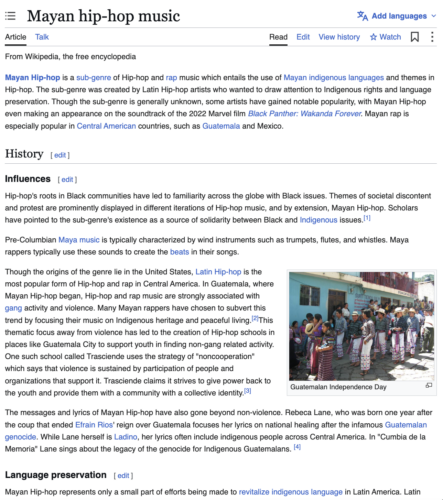
Gonzales can anticipate what his students will learn from the project, but he’s always pleasantly surprised by the topics they choose to explore.
“My goal is for students to gain a deeper appreciation for people, places, and experiences that they had little to no knowledge of previously and this article on Mayan hip-hop music is an excellent example,” said Gonzales. “Neither [student] had any knowledge or exposure to the genre previously. They were drawn to the topic because it illustrated course themes, like the process of migration and acculturation.”
Supported by twenty-six references, the article is now part of public knowledge, available to other students, researchers, and curious readers. Readers will learn about the context for the regional variations of the genre, and discover the stories behind artists like Pat Boy, who has spent years running hip-hop workshops to keep Yucatec Maya alive among young people, or Balam Ajpu, who consult a Mayan priest before writing lyrics.
Now Wikipedia is one more place where people can discover them.
Interested in incorporating a Wikipedia Assignment into your course? Visit teach.wikiedu.org to learn more about the free resources, digital tools, and staff support that Wiki Education offers to postsecondary instructors in the United States and Canada.