Something that is both hidden and obvious about rare diseases is that published research about these diseases is sparse compared to other diseases. This has a compounding effect on Wikipedia — with fewer sources, it becomes much more difficult to represent these topics in the online encyclopedia.
This is one of the many reasons why Wiki Education’s Wikipedia editing courses in collaboration with Rare As One (RAO) are so important. By bringing together experts in rare diseases, we can empower those with the knowledge to fill the related Wikipedia articles with the most exhaustive list of up-to-date sources available.
Our most recent editing course, which ran from October through December 2025, gave more than twenty subject area experts the opportunity to create and expand Wikipedia’s coverage of rare diseases.
This cohort of course participants dazzled during our eight weeks together. Nearly everyone in the course was completely new to editing Wikipedia, and yet this group was able to produce five new articles that did not exist previously. This is a remarkable statistic! Prior to their contributions, Wikipedia did not offer articles about SCN2A-related disorders, Okur–Chung neurodevelopmental syndrome, and KCNA2-related disorders.
It sounds simple, but just by virtue of having these articles exist on Wikipedia, readers can find reliable sources faster, understand the topic better, and other editors can continue to update the content as new research is published.
And it’s not just about creating new articles. Course participants also improved 40 existing Wikipedia articles, adding high-quality sources to bring additional information to readers.
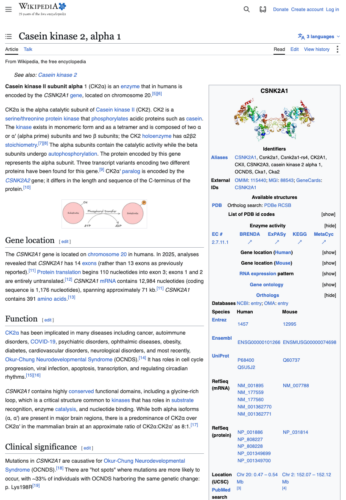
Edits to the Alström syndrome article, for example, highlight how a subject matter expert can spot content gaps in an existing page. Prior to the editing course, the language of the article wasn’t as sharp, and the sections on “Research” and “Signs and symptoms” did not exist. You can see similar outcomes in the article about Multisystem proteinopathy, CACNA1C (a protein), and Casein kinase 2, alpha 1 (an enzyme). Thanks to the efforts of the brand-new editors, now these vital sections exist, and are backed up by high-quality, reliable sources.
Speaking of sources, our course participants kept busy adding 479 references to rare disease articles across Wikipedia. In a time of AI hallucinations and inaccurate answers, readers can take comfort in the fact that these references are reliably sourced, and these sources back up the facts with precision. In total, the cohort made 685 edits, adding 45.6K words to Wikipedia.
Although these are all impressive numbers, what towers above the rest is the number of views on these pages since the course began: 819,000 page views since the start of the course in October 2025!
Every little bit of work on these rare disease articles counts in a big way for readers. The cumulative effect of the participants’ efforts shines through when you consider the number of readers on Wikipedia, how LLMs heavily rely on Wikipedia to produce their answers, and how this information can be easily translated into other languages since it is now on Wikipedia.
Course experiences like this emphasize just how much work is left to do on Wikipedia for rare diseases and beyond. But while there will always be more to contribute, we’re beyond proud to celebrate this successful course and the incredibly meaningful work of its participants.