Gabriel Ashley is a recent graduate of James Madison University in Harrisonburg, Virginia, where he double majored in history and Italian. Through their Wikipedia assignments this spring, Gabriel and his classmates significantly expanded Wikipedia’s content about colors, adding information about the history and science behind specific shades.
Curious about the first formal scientific investigation of the color dragon’s blood, the toxic legacy of the factory productions behind Paris green, or the historic symbolism of khaki? Thanks to the student editors, Wikipedia now offers richer coverage of these colors and many more.
Below, Gabriel reflects on his experience improving the Wikipedia article on Tuscan red, a shade of red that was used on railroad cars and is closely associated with the Pennsylvania Railroad, and shares his big takeaways from the assignment.
To be completely honest, I never thought much about the history of colors before this project, but the research did pique my interest in certain areas. The period from 1880 to 1914 was, as it turns out, one of the most consequential eras in the history of color, a moment when industrial chemistry, geopolitics, fashion, military strategy, and public health collided in ways that determined not just what things looked like, but who got sick, who went to war, and who survived. Contributing to Wikipedia in this context was more than an academic exercise. It was an act of making that history accessible to anyone who looks up a color name. Looking back, I can see that our project to improve Wikipedia’s coverage of color history succeeded as a pedagogical tool precisely because it forced students to confront the gap between what is publicly known and what is historically true, and to do the work of closing it.

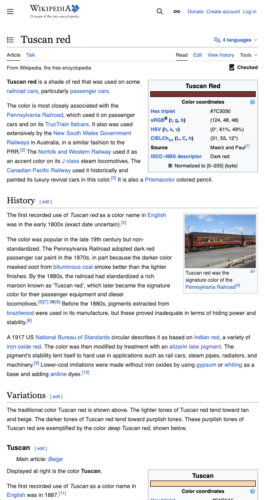
The most important contribution I made to Wikipedia was documenting the 1887 reformulation of Tuscan red, specifically shifting it from a brazilwood base to a compound of Indian red (a variety of iron oxide). This formula was later modified by adding alizarin lake pigment, resulting in the commercial production of the pigment in three distinct shades. This context explains something that the previous version of the Tuscan red Wikipedia article gestured toward but did not fully account for: why the color became so closely associated with industrial applications like railroad rolling stock, steam pipes, and machinery in precisely this period.
The answer is not that the color was fashionable or that the Pennsylvania Railroad happened to choose it, but rather that the reformulation around 1887 produced a pigment that was genuinely resistant to heat and sustained light exposure in a way the earlier brazilwood formulation was not: the material properties drove its industrial adoption. The three-shade production detail — light, medium, and dark, with the medium grade becoming commercially dominant — also reveals the degree to which color had become a standardized industrial commodity by the late 19th century. This was not craft production. This was a market segmenting a product for different end uses and optimizing for the grade that sold best. Documenting that transition from Brazil wood lake to iron oxide and alizarin is, in a real sense, documenting the moment Tuscan red became a modern industrial color rather than a traditional pigment. That distinction belongs in the public record.
The research for this assignment changed my view of color in a fundamental way. I came into the process thinking about color as an aesthetic phenomenon, as a question of what is pleasing or fashionable or symbolically meaningful. I now see color as infrastructure. The color of a railroad car was a standardization problem. The color of a dress was a supply chain problem. The color of a military uniform was a chemistry problem, a geopolitics problem, and an industrial production problem, all at once. The period 1880 to 1914 is the moment when color became industrial at scale, when the decisions about what shade things would be were made not by artists or craftsmen but by chemists, manufacturers, and military procurement officers working under competitive and economic pressure. That shift had profound consequences for ordinary people, most of whom had no idea they were living inside of this change. Paris green, a highly-toxic, arsenic-based pigment, was in their wallpaper, their children’s toys, their ball gowns, and their books, and they largely did not know. Color history is uniquely positioned to illuminate the significance of this invisibility.
 The assignment also changed my view of Wikipedia, and in a direction I had not expected. I came in with the casual undergraduate assumption that Wikipedia is a starting point, a place you go before you do the real research. I leave with considerably more respect for the platform and considerably more appreciation for how difficult it is to contribute to it well. The verification requirements are not bureaucratic obstacles; they are the mechanism by which the platform maintains the distinction between what is known and what is merely asserted. When I discovered that several of my initial facts were already present in the relevant articles, sometimes nearly verbatim, I had to go back and do much more time-consuming research to find what was genuinely absent. That process was frustrating, but it was also the most educationally valuable part of the assignment. It forced me to read the existing articles carefully, to understand what they already said and what they were missing, and to think critically about what kind of knowledge actually needed to be added. That is a different and more demanding skill than simply summarizing sources.
The greatest benefit of this assignment was the experience of doing research with a genuine audience. Writing for Wikipedia is not the same as writing a paper for a professor. The professor knows more than you do and is evaluating your command of the material. A Wikipedia reader may know nothing about the topic at all and is relying on the article to orient them accurately. That shift in audience produced a shift in how I thought about evidence, clarity, and the responsibility that comes with putting information into a public space. The greatest challenge of the project was closely related: the existing articles were better than I expected, and finding material that was both genuinely new and properly sourced required more time and more methodological rigor than I had initially anticipated. Several promising facts turned out to be already present on the page. Others were well documented in secondary sources but not traceable to primary sources that would satisfy Wikipedia’s citation standards. The constraint was productive, but it was genuinely difficult.
Now looking back, I can see that the biggest value of the assignment is the bridge it builds between rigorous historical research and public access to knowledge, and in the experience of learning to take both seriously.
Interested in incorporating a Wikipedia assignment into your course? Visit teach.wikiedu.org to learn more about the free resources, digital tools, and staff support that Wiki Education offers to postsecondary instructors in the United States and Canada.