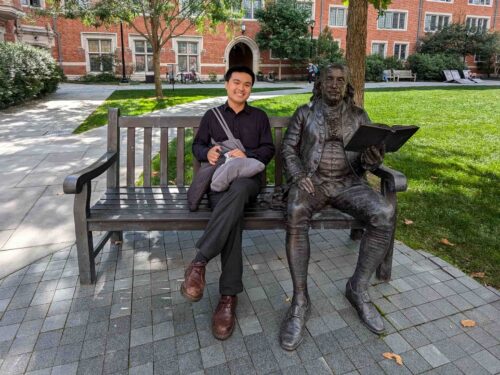
Alvin Khiêm Bùi is Assistant Professor of History of Asian Peoples in Diaspora at Brooklyn College, City University of New York. Here he reflects on the interaction between editing and teaching with Wikipedia in the history and Asian American Studies classrooms at public institutions of higher education.
Wikipedia and Me
My journey to teaching with Wikipedia (the “Wikipedia Assignment”) was a circuitous one, but perhaps one that was destined to happen. I was most active in editing Wikipedia in my teenage years. Until interacting with other Wikipedians in the flesh at WikiConference North America 2025, I did not realize that meant I was an “early adopter”.
As my time shifted to other hobbies and my academics, Wikipedia remained in my life as a tool for ideating topics and learning new things, usually by “going down ‘Wiki rabbit holes’”. As I (re)learned Vietnamese and learned French and Chinese, I read the same Wikipedia article/topic in these other languages to compare how robust they were. This practice led to at least the seed for one of my dissertation chapters. In particular, I found an incident within the migratory aftermath of the Vietnam War (the “Indochina [‘boat people’] refugee crisis”) that (at the time) only had Wikipedia pages in Chinese, rather than in Vietnamese, English or French. This initial contact led to Chinese-language secondary and primary sources, and eventually an entire chapter of my writing.
As I formulated syllabi for my first undergraduate classes as a professor at CUNY Brooklyn College in the Spring semester of 2025, I reflected on my own undergraduate experience in the history classroom and the path I took to returning to academia to complete a PhD in Southeast and East Asian history. I knew that given my own pathway to “finding my research interest” could be applied to the classroom through the Wikipedia Assignment. At the very least, it would be a novel way to approach assessment in the new world of Generative Artificial Intelligence (GAI).
Wikipedia and Sources
As an undergraduate student, I did not understand why so many of my history instructors had us read primary sources. Unless the primary source was in a “primary source reader” with an introductory essay, or read in-class with the guidance of the instructor, most students were pretty lost. Primary sources, even from countries/places whose histories I was interested in, never really moved me (a motivated double major in History!) in my undergraduate classes.
Conversely, Wikipedia’s preference for citing secondary sources aligned well with my thinking on historical pedagogy. Before I experienced for myself the ability for a well-selected primary source to bring course content to life, I found “the world of secondary sources” (historiography or literature review) and the existing content on a Wikipedia page (a tertiary source) more manageable. And it was not until I read more secondary sources in Vietnamese Studies that I figured out what scholarly research methods best aligned with my ambivert personality and where I saw the “gap” in the literature/historiography that I hoped to help fill. Reading compiled primary sources was like looking at court cases (also a primary source) where the verdict was already out!
The Wikipedia editing process simulates a highly scaffoldable portion of the literature review (or historiography) of the research process with public audiences in mind. Students find and understand secondary sources as they figure out what their “contribution” to related Wikipedia pages is. Often, this is to find “the gap” in the current literature/historiography. Student editors edit the Wikipedia page so that it accurately reflects and/or includes content from the secondary sources they read, and then cite those sources. While many students are worried about how to correctly write a citation in MLA/APA/Chicago format (a process which the Wikipedia editor can now more or less automate with DOI or ISBN numbers), the Wikipedia Assignment helps reorient students toward “doing the reading carefully” as the bulk of the work.
Prior to working in a Wikipedia sandbox, where students can draft their contributions before publishing them, I ask students to turn in annotations of the articles/chapters they read along with a corresponding worksheet that I use earlier in the semester to show them how to digest a peer-reviewed historical journal article (based on Professor Zachary Schrag’s The Anatomy of a 30-Page Paper). Students suggest changes to their Wikipedia pages on this worksheet, to which I reply with feedback. Thus I can give students a structured introduction to the public-oriented research process that captivated me as a teen stumbling onto this large, not-for-grades “group project”.
The most compelling reasons for editing Wikipedia have remained much the same as Professor Rachel Tamar Van’s laid out in her 2019 reflection, now with various GAI and Large Language Models (LLMs) services augmenting and replacing “Google”. It’s more important than ever to understand the role of content on Wikipedia (visible or otherwise) in GAI/LLMs’ responses. By asking students to contribute to Wikipedia’s “base of historical knowledge”, it brings up the question of what constitutes theft and plagiarism (versus “verifiablity”) when it comes to the training of LLMs. The Wikipedia Assignment shows that there is still great value in teaching and refining the human ability to “verify” (or the verifiability that facts/claims come from reliable sources), a key policy of Wikipedia at which GAI still struggles. Wikipedia’s general prohibition of “use of large language models such as AI chatbots to create or rewrite articles, generate images or comments, or be used as sources” provides this conversational touchpoint.
Asian American History
This process of reading, verifying and editing is especially important in the fields of history in which I teach: our general education course focused on “‘global’ history from 1500-present” and migrations/diasporas from Asia, including, but not limited to the relatively “young” field of Asian American History, with the concept of “Asian American” coined by historian Yuji Ichioka in the late 1960s. With a second undergraduate major in Asian American Studies, I knew from my West Coast classrooms that it was a privilege to have such a robust amount of courses available to me. Most East Coast students do not have such a privilege (indeed, the Association of Asian American Studies has a section called “East of California”).
This is where Wikipedia’s Knowledge Equity initiative and CUNY’s mission of “provid[ing] a public first-rate education to all students, regardless of means or background” align. Brooklyn College, in particular, showcases this mission, as we have attracted a student body that has ranked among the top (if not the top) in ethnic and economic diversity indices across the nation.
We do not need to go outside the borough of Brooklyn to see Asian American history. Beyond migration histories to neighborhoods like Sunset Park (see the work of Tarry Hum) and Bensonhurst, Asian Americans have been involved in events in NYC interracial relations such as the 1990 Flatbush boycotts (see the works of Claire Jean Kim; note how a shorter piece by Kim is referenced in the article, but not her 2001 book; meanwhile, most of the references are to primary sources—newspapers articles from 1990-1991) and the building of multiracial coalitions in the face of different forms of “state-sanctioned removal” (see Vivian Truong’s article in the Journal of Asian American Studies). My next goal is to have students cite exhibits created by youth researchers of the Localized History Project, housed at CUNY’s Asian American/Asian Research Institute, in the hopes of bringing the Project to a broader Wikipedia audience.
As I remind my students: they and their family’s taxpayer and tuition money makes CUNY, the “nation’s largest urban public university”, possible, and CUNY in turn makes access to a wide array of paywalled peer-reviewed academic secondary sources possible. We have an imperative to build upon the current (free!) draft of “the sum of all human knowledge” with our access to these sources behind the paywalls. For future historians, this is but one corner of the internet where they can find the hopes of millions of netizens living in the early 21st century participating in what I like to call “the biggest group project you’ve ever worked on”.
Interested in incorporating a Wikipedia Assignment into your course? Visit teach.wikiedu.org to learn more about the free resources, digital tools, and staff support that Wiki Education offers to postsecondary instructors in the United States and Canada.