In January, Wiki Education published a widely read blog post about our experiences with Wikipedia editing and generative AI chatbots like ChatGPT, Claude, Gemini, and Copilot. It sparked lots of conversation both on and off Wikipedia. Now, six months later, we’d like to provide an update on what we’ve learned since it was published.
Verifiability remains a central concern
In the first half of 2026, we continued to run edits our program participants made to Wikipedia through Pangram, an AI detector, and automatically email participants if Pangram flags their text as being AI generated. Importantly, we do not use Pangram as definitive proof that the text was AI generated. Instead, we use Pangram as a way to flag which text needs additional human scrutiny for verifiability.
Verifiability is a core policy on Wikipedia ([[WP:V]]). Essentially, it means a claim added to Wikipedia should contain a source, and if the reader clicks through to that source, they should be able to verify that claim is contained in the source.
In our experience, generative AI chatbots, when prompted to, will write encyclopedic text that contains claims and a citation for those claims. Frequently, however, these claims are not actually verifiable. In other words, if you click through on the citation the AI chatbot gives you, the claim will not be in that source it has attributed that claim to.
Unverifiable content is bad for Wikipedia. It undermines the credibility of the project, and any information that can’t be verified in the source that it’s cited to should be removed.
When we use Pangram as an AI detector, we are not doing so to attempt to “catch” people “cheating” with AI. Instead, we are doing so because we’ve found a positive signal from Pangram is correlated with a strong likelihood that the text will fail verifiability.
How we handle generative AI usage
In March, the English Wikipedia community created a new guideline that banned adding text from generative AI chatbots to Wikipedia. This follows the guidance we’ve been giving our program participants since mid-2025: Never copy and paste text from a chatbot into Wikipedia. English Wikipedia currently allows AI-assisted translations as well as minor copyediting, although we discourage both of these. We’ve created training modules, recorded videos, offered office hours, emailed guidance, and replied to numerous participant emails reiterating this position about AI-generated content and Wikipedia.
For those who want to use AI, Wiki Education recommends confining it to the research and feedback phases. Our experience suggests AI tools can be useful in surfacing useful sources to consult, introducing topics that should be included in an article, and providing feedback on human-drafted text, such as suggesting categories to add an article to. But the verifiability concerns mean it should not be used to draft text.
Overall, our interventions and guidance seem to be working: Results from the team of researchers looking into our participants’ AI usage — Francesco Salvi and Manoel Horta Ribeiro at Princeton University, Robert Cummings at the University of Mississippi, and Sage Ross at Wiki Education — shows a decrease of articles flagged by Pangram for AI usage term-over-term since we began doing interventions in mid-2025. The graph included in this post shows by term the percentage of content added by our Wikipedia Student Program participants by term that Pangram flags as being AI generated: Near-zero articles until the launch of ChatGPT, then a steady increase, peaking in the spring 2025 term. Our guidance and interventions began at the start of the fall 2025 term, leading to a drop in percentage of detected AI usage to just above 10%.
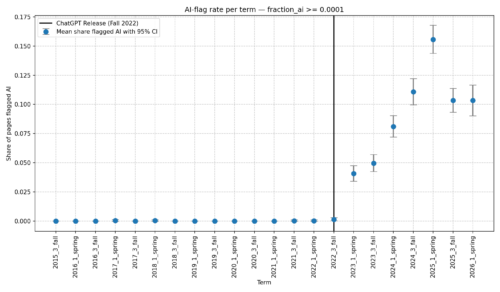
When Pangram flags text (that 10% shown in the chart), Wiki Education’s staff removes that text from Wikipedia’s article namespace if it was added there. (The majority of hits we get from Pangram come from work in editors’ userspaces, such as a sandbox draft or an early exercise.) We then ask the program participant who added the text to confirm the verifiability of each claim, quoting the paragraph they’ve summarized and cited. If they’re able to do so, we determine the text is allowable on Wikipedia; if they are not able to do so, we ask they not move it live again.
University professors in our Wikipedia Student Program (where the majority of program participants we bring to Wikipedia come from) responded well to our approach; 87% of faculty who received alerts in our end-of-term instructor survey rated these messages as somewhat or very useful in their classes.
What we’re doing moving forward
Generative AI is a changing landscape, and we continue to monitor developments in technology, in detection, and in the Wikipedia and academic communities’ responses to generative AI. In the coming months, we are tweaking our resources to meet the needs of the moment, but this won’t be their last update.
Two larger changes we’re rolling out are a new exercise on verifiability and a rethinking of the peer review process to center verifiability. In the new exercise, participants will select an article that included text added to Wikipedia by a past participant flagged by Pangram. They’ll read the source it’s cited to, and attempt to verify the information. Our goal is that by explicitly front-loading the idea that generative AI chatbots often produce unverifiable information, well-meaning participants will understand the drawbacks and avoid using them.
Similarly, in our new peer review exercise, we will emphasize claim verification as a critical piece of the evaluation process. Participants will be asked to review text added by their peer and see if they can verify the information in the sources cited.
We also continue to monitor AI detection software. While we’re happy with Pangram as a tool to detect text that should have further human scrutiny, we have no good way of assessing its false negatives (as in, text Pangram says is human but was actually created by AI). As AI humanizers and other tools become more sophisticated, it’s important to ensure we are doing everything we can to flag content that should have additional verification checks done. And we are interested in a more broad automated claim-source verification process, which would be useful across Wikipedia. We’re actively seeking ways of addressing this, so please get in touch if you have ideas!
Want to learn more about AI and Wikipedia? Our next edition of our Speaker Series is themed around just that! Save the date: Wednesday, September 2, at 10 am Pacific / 1 pm Eastern. Sign up to be notified about this and future Speaker Series events at www.wikiedu.org/speaker-series