Diego Fleury Mendible may have been the one to create Wikipedia’s new article on the estrobolome, a part of the human gut microbiome, but he’s quick to give credit to his inspiration for the project.
As he considered topics for his Wikipedia assignment at North Carolina State University last term, Fleury Mendible’s mother joined the brainstorming session, bringing her own interest in microbiology and recent reading on the gut microbiome to the conversation.
“I took the inspiration from my mom for the topic,” explained Fleury Mendible. “Her father was a geneticist, and I can definitely see his fervor for science seeping through her. This article felt like my own way of channeling that learning and curiosity into something that can help others learn about a topic. Crafting this article helped me feel closer to both of them, even through my own work.”
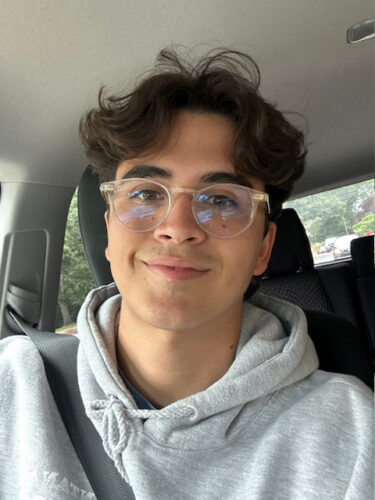
But Fleury Mendible hasn’t always studied the life sciences — he completed his bachelor’s degree in political science before beginning his graduate studies in physiology this year. To push himself to fully engage with the materials and to test his understanding, he decided to take on the additional challenge of developing a brand new article.
“I chose to create an article because this was one of my first experiences with microbiology in general, so I thought that putting lots of work and research into crafting something of my own would be a great way to learn how to apply the concepts we were discussing in class,” said Fleury Mendible. “It did end up helping those concepts to stick and sharpen my understanding.”
For Fleury Mendible, the real challenge wasn’t just searching for high-quality, peer-reviewed sources appropriate for Wikipedia, but also ensuring his understanding was shaped by the research rather than starting with his preliminary understanding of the topic.
“It can be tricky to find articles that fit [the] criteria without trying to conform the details of the papers to preconceived notions about any given topic,” he noted. “In a chicken-before-the-egg scenario, I did not want to find articles that fit what I thought I knew about the estrobolome; rather, I wanted to take what I knew and have it evolve through reading about it in the literature.”
Using this approach, he built the article from as neutral a point of view as he could. That focus, along with the other Wikipedia guidelines and standards he learned throughout the project, gave him a deeper appreciation for how the online encyclopedia functions and grows.
“From the neutral tone and solid sources required to the scrutiny of thousands of reviewers, this forum is one where people can learn about the ever-changing world we live in,” said Fleury Mendible. “The learning modules [in the assignment] encouraged being okay with scrutiny and changes in articles, and to me, that is the core of what Wikipedia is. We can learn, grow, and change while maintaining a learning environment fit for anyone. The fact that it is free and held up by people who contribute simply for the community is amazing too!”
Reflecting on the project, Fleury Mendible underscored how the Wikipedia assignment stands apart from other coursework in both scope and stakes.
“This was unlike anything I have done in a classroom setting before,” said Fleury Mendible. “From the moment I read about the assignment, it felt like an opportunity to make something my own while contributing to the knowledge of the world. I really enjoyed the freedom granted to us as students.”
Although his academic path will keep him busy (he plans to attend medical school next!), Fleury Mendible didn’t hesitate when asked whether he’ll continue editing Wikipedia.
“Of course! I am proud of my work and would love to stay involved with it,” he said. “I look forward to seeing what the community will contribute and how this article will evolve over time.”
Our support for STEM classes like Diego Fleury Mendible’s is available thanks to the Guru Krupa Foundation.
Interested in incorporating a Wikipedia assignment into your course? Visit teach.wikiedu.org to learn more about the free resources, digital tools, and staff support that Wiki Education offers to postsecondary instructors in the United States and Canada.