Picture a parasite. The animal you picture probably isn’t the same as what someone else does, it probably fits E.O. Wilson’s description: “predators that eat prey in units of less than one”.
But the hoverfly Microdon mutabilis is a different kind of parasite. Adult flies linger close to ant colonies, and their larvae feed on their eggs and larvae. Rather than being a parasite in the typical form, they are social parasites — in essence, very bad houseguests who exploit the social bonds of an ant colony.
When Saty Paynter-Tavares had to pick a Wikipedia article to improve as part of her Insect Diversity and Evolution course, Wikipedia’s short article on Microdon mutabilis seemed like an obvious choice.
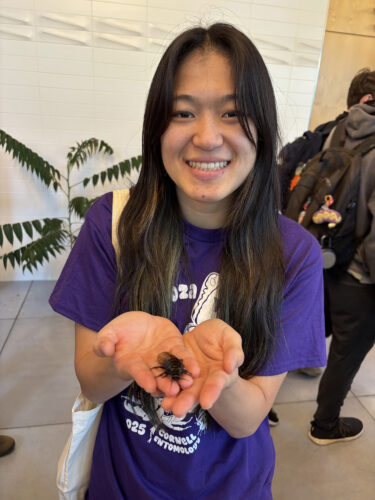
Paynter-Tavares is a senior and entomology major at Cornell University. In the semester before she did the Wikipedia assignment, she worked on a curation project working on flies in the genus Microdon and found their biology and life history to be fascinating.
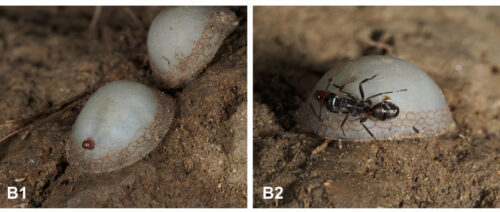
Female Microdon mutabilis flies use chemicals produced by the ants to locate a suitable nest for laying their eggs. Their small, slug-like larvae fly under the radar while wreaking havoc on ant eggs and larvae since their hosts apparently can’t recognize them as invaders.
Reflecting on her goals for the project, Paynter-Tavares said, “I really wanted to highlight the life history and biology of Microdon mutabilis — its host specificity and myrmecophilous lifestyle is one of the quintessential features of this species and is what makes it so interesting. There are a lot of avenues for further research associated with these traits alone.”
Anyone who’s ever been a student is familiar with the challenge of getting big projects completed on time. This can be doubly challenging on Wikipedia, where in addition to the desire to find one more source, you’re surrounded by Wikipedia itself with its innumerable rabbit holes. With that in mind, Wiki Education designed the Wikipedia assignment to mitigate this problem.
As Paynter-Tavares put it, “We were fortunate to have a timeline and activities provided to us, so it was easy to stay on track by completing smaller tasks throughout the semester. I first assessed the original article to see what was already available, then I conducted research and jotted down notes from peer reviewed sources I consulted in a separate document. By having all the information laid out for me in bullet points, it was a lot easier for me to synthesize the information and flesh out the article.”
As they contribute to Wikipedia, students expand the body of information that’s out there for people to use as a starting point for further work. In the case of this hoverfly, there’s a lot that’s still unknown, and students like Paynter-Tavares help to highlight the research still needed. “I wanted to add to the repertoire of easily accessible knowledge to highlight the potential for further systematics and conservational studies for this species,” said Paynter-Tavares.
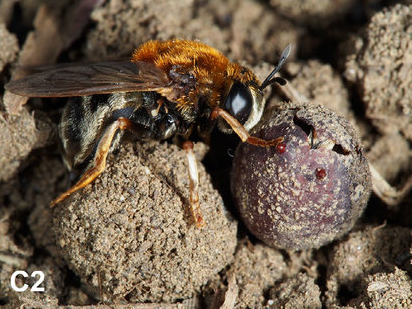
Microdon mutabilis can only be distinguished from Microdon myrmicae, a closely-related species, by the anatomy of the pupa. Until 2002 they were both thought to be part of a single species. The article said this before Paynter-Tavares started improving it, but it did so in a manner that was neither particularly informative nor accessible: “See references for determination.”
Here again, Paynter-Tavares had something important to contribute. “I already have a strong background in the biological sciences, but this article was helpful for communicating my knowledge in a way that is accessible to those who might not have a strong science background.”
In writing for more general audiences, she also built skills that might be useful in her future. “I see myself being most fulfilled in a career involving evolutionary biology and scientific outreach, and would love to work at a zoo, museum, or research station.”
Finally, doing this kind of work engages students in what they’re writing while giving them agency.
Reflecting on her experience, Paynter-Tavares said, “I really enjoyed this assignment compared to a traditional assignment. It was a lot easier for me to be engaged because it was largely self-driven on a topic that I found interesting.”
Not only was she able to find an interesting topic relevant to her major in entomology, but she also appreciated the research and writing process, all building up to her article contributions.
“I enjoyed compiling all the information that I learned into one cohesive document,” Paynter-Tavares explained. “It was really satisfying to see my article come to fruition after the countless hours of researching and drafting.”
Our support for STEM classes like Saty Paynter-Tavares’ is available thanks to the Guru Krupa Foundation.
Interested in incorporating a Wikipedia assignment into your course? Visit teach.wikiedu.org to learn more about the free resources, digital tools, and staff support that Wiki Education offers to postsecondary instructors in the United States and Canada.