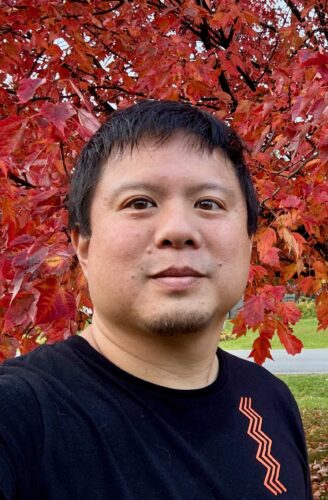
David Minh is the Robert E. Frey, Jr. Endowed Chair in Chemistry at Illinois Institute of Technology and the Co-founder and Chief Scientific Officer of Biagon Inc.
Introduction
This semester was the first time I had students complete the Wikipedia assignment, where they evaluated and made edits to an article in the free online encyclopedia. At the end of the assignment, they completed a reflective essay describing what they learned and summarizing their contributions. I thought I would also write one from the perspective of an instructor.
Motivation
I was teaching Chemistry Colloquium, in which visiting speakers present about their research. The students are advanced undergraduates and graduate students. In the past, I have graded them based on attendance, participation, and writing summaries (for the undergraduates) and research proposals built on the presented work (for the graduate students). Their work varied greatly in effort and quality and I often did not enjoy reading (or grading!) them. I decided to adopt the Wikipedia assignment because I hoped that students would be more motivated to put solid effort into public-facing work that would have an impact beyond the classroom.
Preparation
I applied to and was accepted into the Wiki Education Student Program. They referred me to a mentor and we met before the semester. It was reassuring that he was an experienced professor from a similar field as mine and had given the assignment for many years.
I adjusted my syllabus in a few ways. First, I added these learning objectives:
- Identify reliable sources for information about chemistry.
- Evaluate the quality of scientific writing for a public audience.
- Organize and summarize information about chemistry from multiple sources.
- Contribute to Wikipedia, a free online encyclopedia. I also added the assignment and adjusted grading accordingly. I gave points for completing the training modules at two points during the semester and made final contributions due at the end. I kept other assignments, but reduced how many the students would be required to complete. Finally, I added two discussions to the course schedule.
Execution
Two class sessions were dedicated to discussions related to the assignment instead of speakers. The first was a few weeks into the semester, when we discussed sources and plagiarism. The second was two months into the class, when students had the chance to start the assignment, exchange peer reviews, and receive some feedback about their contributions. The discussions were prompted by questions provided by the Wiki Education Student Program as part of my Wikipedia assignment resources, so they were pretty easy to prepare for. I wasn’t sure what to expect, but both times students appeared quite engaged. While some were reluctant to speak, many openly shared a range of opinions about the topics. I also shared my own perspective informed by experiences as an author of many scientific journal articles. There was a lot of lively discussion about AI, including whether it has made Wikipedia obsolete.
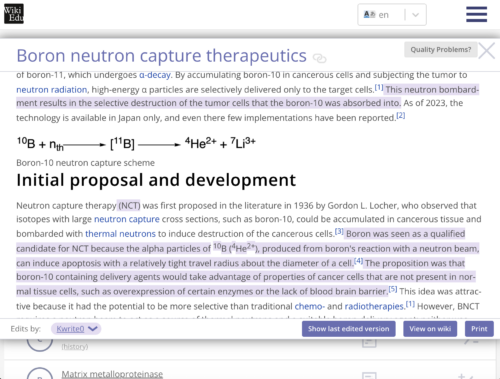
Throughout the class, there were some hiccups due to technical problems or novice users. While the Wiki Education Dashboard was very helpful, it did not always accurately reflect how much progress the students had made, so I had to correct a few grades. One student tried to do the assignment on her phone, but the web interface was not as well-developed as for other computers. Several times, I received alerts about suspected AI-generated language in student edits, but at least one student convinced me their work was original.
Contributions
When grading the assignment, I looked over student contributions and compared them to the live articles. Some edits stuck, but many were removed by other editors for various reasons. Because of this, I wasn’t sure that we added much. Then in mid-December I received an email describing contributions from the Wiki Education Student Program. It said, “You and your students are part of a cohort of 343 courses whose 6352 students contributed 4.67M words to Wikipedia so far. This is an incredible feat, and we couldn’t have done it without you!” It was encouraging to know that my students and I were part of a larger collective effort to improve the encyclopedia.
At the time of this blog post, my Chemistry Colloquium course page says that 16 students edited 46 articles 394 times, adding 17.6K words and 143 references. The edited articles are estimated to have been viewed 4.64 million times. I know that one student was already an active Wikipedia editor, but many contributions would not have happened without the assignment.
Student Reflections
Beyond impact on the encyclopedia, the Wikipedia assignment was an educational experience for the students. Feedback from the students was uniformly positive. As I had hoped, students found the assignment highly motivating. They also developed a better understanding of evaluating sources and science communication. Finally, they changed their attitudes about Wikipedia itself.
The following excerpts from student reflections illustrate how the assignment and discussions impacted them.
Increasing motivation
- “presents an absolute contrast to conventional term papers; the potential audience encompasses a global readership, and the implications are significant, as millions of individuals may engage with the content. This necessitates a commitment to neutrality and rigorous citation practices in one’s writing.”
- “taught me that [Wikipedia] is more than merely a website; it is a collaborative knowledge ecosystem that depends on transparent sourcing, clear communication, and community oversight. Writing for a broad audience required me to balance scientific accuracy with accessibility, which differs greatly from writing for academic instructors or scientific journals. Unlike typical coursework, this project has a real-world impact: anyone searching for information about [topic redacted] will encounter a clearer, more historically grounded, and more scientifically accurate article because of these edits.”
Evaluating sources
- “provided insight into how scientific knowledge is constructed, reviewed, and communicated to a broad public audience, and it challenged me to think carefully about accuracy, sourcing, and accessibility.”
- “in an age where AI is becoming more and more prevalent, understanding how to go deep into topics without it and learning how Wikipedia works was very interesting and important.”
- “Overall, the Wikipedia editing process has taught me a lot about doing original research without relying on search engines and artificial intelligence to produce quick answers. Even though this is very challenging, it serves as an important lesson in doing research and writing scientific papers in the future.”
Communicating science
- “was one of the most eye-opening assignments in my academic experience. I had always relied on Wikipedia as a convenient reference tool, but contributing to the platform helped me understand how much effort goes into shaping publicly accessible knowledge.”
- “was a meaningful and transformative experience that reshaped my understanding of how public scientific knowledge is built, evaluated, and shared. This assignment challenged me to learn new editorial skills, engage with collaborative digital spaces, and think critically about how complex scientific topics can be communicated to a global audience.”
- “changed my perception of how to convey public science to a general audience.”
Attitudes towards Wikipedia
- One international graduate student wrote, “When I was an undergraduate student, I was asked to do a lot of presentations. I remember a professor giving zero points to a student who made his presentation from Wikipedia. The professor said that Wikipedia is an unreliable source and I always had that on my mind. Sometimes I get all the information I need from Wikipedia and then I must go around looking for another source and I most probably used the references mentioned and the surprise was that I got the marks and I received all the points for that presentation. Just the name of Wikipedia did not receive much credibility in my home country. I started colloquium and it was very impressive for me that we can edit and publish work on Wikipedia. I thought it was going to be easy, but it turned out otherwise. The training was helpful; the system and its rules and criteria to evaluate an article and peer reviewing it made me think that Wikipedia can be a reliable source as a product of a responsible community.”
- An undergraduate student wrote, “Wikipedia is a website that I was always told to stay off of. Teachers never saw it as a credible source and this made me believe that the information provided could be wrong. When I first looked at the syllabus for this class, I was confused with what the Wikipedia assignment would entail, but I was pleasantly surprised with the depth of the training and information that was provided. I learned that Wikipedia articles are shaped and edited by hundreds of people taking information from different and carefully chosen sources and references. The training modules offered a step by step process on how to complete and get through writing your own article. They also taught me how to approach another article and evaluate and critique others and my own.”
Prospectus
Given how effective and well-received it was, I would love to offer the Wikipedia assignment again. I do not teach the chemistry colloquium very often, but I will keep it in mind when planning other courses. Perhaps I will integrate it into an unrelated course in a different way!
Wiki Education’s support for STEM courses like David Minh’s is available thanks to the Guru Krupa Foundation.
Interested in incorporating a Wikipedia assignment into your course? Visit teach.wikiedu.org to learn more about the free resources, digital tools, and staff support that Wiki Education offers to postsecondary instructors in the United States and Canada.