Co-authored by Colleen McCoy
Wikipedia is a first stop for many patients, caregivers, and practitioners with health related inquiries because of its open access and simple, accessible writing style directed at a global audience. Considering the online encyclopedia’s wide readership, any gaps or inaccuracies in health related topics can become additional barriers in accessing necessary information. Addressing these gaps with additions of well sourced, accurate information makes a profound difference in the reliability and accuracy of Wikipedia as a vital resource for communities that face barriers to care.
We hear often from faculty and students working on the Wikipedia assignment that the project is even more meaningful when the student feels a personal connection to their chosen topic. For student Brett Richards, this was especially true when he decided to improve the Assistive technology article as part of his Cultures of Disabilities course at the Albany College of Pharmacy and Health Sciences.
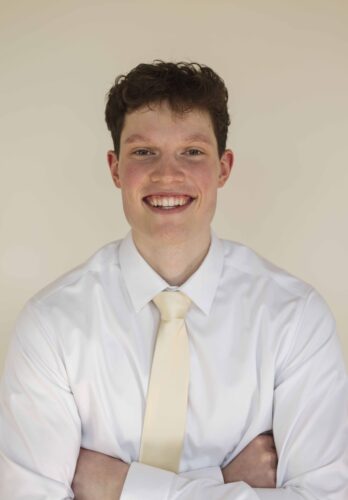
Richards, a recent graduate in Health Sciences, shared that his father has a rare form of muscular dystrophy (desmin myopathy) that creates physical limitations. Their family has been looking into assistive technology to overcome some of the barriers he faces.
This personal experience followed him into the classroom, aligning with one of the primary investigations posed by the course.
“One of the main focuses of my class this semester was asking the question, what impacts a person’s experience of disability?” explained Richards. “I found that before editing, the article focused on only the assistive technology itself, but not any difficulties people may face while trying to use it. To understand what would impact someone’s experience in using assistive technology, I felt it was important to understand the stigma and barriers they may face.”
Drawing on his father’s experience, Richard developed a clearer sense of what the article was missing. He researched and evaluated reliable sources, then wove the findings into the article in a neutral, encyclopedic tone, all while keeping the human experience at the center of his contribution.
“Yes, assistive technology exists, and it can help people, but there are more steps to overcome,” said Richards. “Is their environment accessible for them to use it? Will others be accepting of it? Is it affordable? Just because a potential solution exists does not mean it is the solution.”
Richards’ experience editing Wikipedia is just one example of the WITH Foundation’s support for postsecondary student editors in action. Thanks to the WITH Foundation, students across the country are adding reliable information in an area that is underresearched and typically relegated to academic papers, ensuring that Wikipedia’s disability healthcare content is more complete and inclusive for readers worldwide.
“Many people are deterred by papers that seem confusing or complex, but are willing to read Wikipedia articles,” said Richards. “If more additions to Wikipedia about disability healthcare are made, then more people will see and learn about it as they read the articles.”
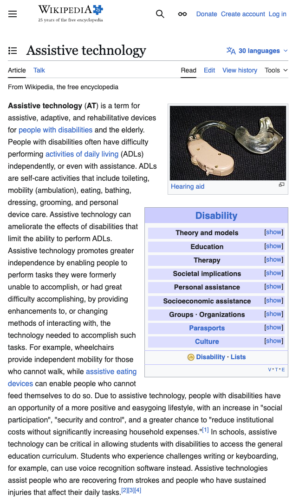
Richard’s assignment also reshaped how he thinks about Wikipedia itself.
“I was very surprised to learn how much goes on behind the scenes in producing Wikipedia pages,” said Richards. “For example, it never occurred to me that the “Talk” feature existed. All throughout middle school and high school teachers emphasized that anyone can add to Wikipedia, but failed to mention all of the fact-checking, discussions, editors, and more that are happening behind the scenes.”
Beyond his personal connection to the topic, Richards found the structure of the Wikipedia assignment uniquely rewarding.
“The Wikipedia project was the best semester-long project I’ve been assigned in my college career,” said Richards. “The weekly modules allowed me to practice the skills needed to edit Wikipedia while also guiding me in how to think about my topic. Each week, I built important research skills and also learned more about assistive technology. Being able to say that not only did I enjoy a project, but also made a positive impact in disability healthcare, is a great feeling!”
Next up, Richards plans to attend SUNY Upstate Medical University for a Master’s in Clinical Perfusion, but he already has a retirement hobby picked out — editing Wikipedia!
Interested in incorporating a Wikipedia assignment into your course? Visit teach.wikiedu.org to learn more about the free resources, digital tools, and staff support that Wiki Education offers to postsecondary instructors in the United States and Canada.