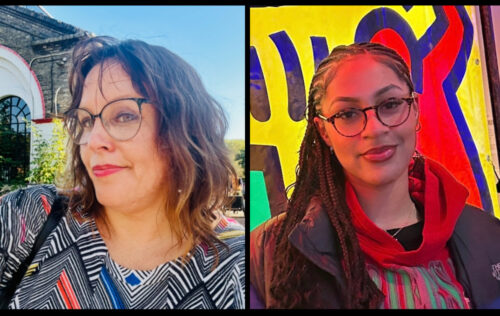
Jennifer Lynn Stoever is an Associate Professor of English at Binghamton University, Editor-in-Chief of Sounding Out!, and author of The Sonic Color Line (NYU Press). She is an interdisciplinary scholar who researches the role of sound in constructing racial identities. Her current book-in-progress details how Black women and their record collections were fundamental to the creation of Hip Hop.
I was so lucky to get an opportunity to talk with my former student Paris DeFreitas this semester, one of the busiest and most inspiring people I know! Paris was in the first class I taught with the Wikipedia assignment: “Black Women and Creativity 1960-1980” at Binghamton University in Spring 2024. Paris was then a sophomore, a first generation university student majoring in Philosophy, Politics, and Law and minoring in Africana Studies. She was already a leader on campus, fostering creativity as the Publications Coordinator of the Black Student Union and the editor of the Vanguard, a showcase for Black artistry. Paris herself is a poet and a photographer, and creativity infuses everything she does, including her scholarly research. Paris is now in her first semester of a Master’s Degree in Public Administration at Binghamton, a big step on her way toward her goal of becoming an attorney and increasing the amount of Black women lawyers in the US. It was thrilling to revisit our semester together, reflecting on what we learned through learning to edit Wikipedia and celebrating Paris’s intellectual journeys since then. Enjoy our dialogue!
—
Jennifer Lynn Stoever: Hi Paris! It’s so great to catch up with you! It’s been a little over a year since we worked on the Wikipedia assignment together. Looking back, what do you think was the most valuable thing you took from it?
Paris DeFreitas: I think the most valuable thing I took from the Wikipedia assignment was the importance of well-sourced information to be disseminated and accessible to the general public, especially the role college students must play to make this possible. Universities as conductors of research who have prolific libraries means that they should contribute their part in making that information available to communities so everyone can benefit from it.
On that note, what do you hope to accomplish in the use of Wikipedia assignments in your classes?
JLS: I really want students to learn how knowledge is made, that there are politics behind the status quo of history, especially regarding who is remembered and represented and how their story is told. In order to get a fuller and more accurate portrayal of our past and present — one that’s more diverse and presenting multiple perspectives — we need all hands on deck. I want to show students that they can make interventions in the world of knowledge production right now, that they don’t have to wait! I want to give them the know-how, support, and courage to make edits on Wikipedia and share the information about Black history they are learning with their friends, family and the world! We can all share the facts we have learned from academic sources about people, communities and events we care about, especially when we don’t see them in Wikipedia. Students are powerful and their perspective really matters — and it really matters right now!
Hopefully you felt some of that in our time together, and that working on editing a Wikipedia article presented you with something different than a traditional research paper assignment. Actually — how do you think the assignment stacked up in comparison? What was different from writing an individual paper assignment on the artist you chose, LaToya M. Hobbs?
PD: In terms of how the Wikipedia assignment was in comparison to a traditional research assignment, there was a big difference in how citations were sourced and written. There was a major difference in the technical aspects of Wikipedia and in learning to remain neutral and unbiased. In addition, a typical research paper usually has strict guidelines in terms of page count, but for Wikipedia editing, it was mostly based on how much you can gather from the sources you found on your artist. This was perhaps the most significant difference between a research report and crafting a Wikipedia article from scratch.
A new question for you: how will you go about choosing the next batch of artists that you want your students to focus on and build articles for? Would it be plausible for future students to build on the artists from previous classes?
JLS: That’s a great question. I have done the Wikipedia assignment twice now. The first time was in your class in Spring 2024, and I selected artists whose paintings were in the university art museum because I wanted you to be able to see their artwork up close. Last year I tried something different. I came across these really fantastic oral histories on Black artists published by BOMB Magazine that gave a great insight into the artists’ lives and gave students some starting places for their research and a flavor of their voices right away. I selected four artists who were working in the 1960s and ‘70s whose articles were underdeveloped, and students selected from that list.
I really love the idea of having students build from the articles of previous years of the class. It’s definitely plausible! As much as I want to spread the love around and get more artists’ articles built out, it’s also really special to create ongoing links between students across time, to work on a project larger than you. I know it meant a lot to this years’ class when you came to the Edit-a-Thon with a couple of last year’s students.
Speaking of, was it like walking into the room in Spring 2025 as an alumni of our class? What did you reflect on?
PD: I think this past year walking into the room was very different than my year, particularly due to the location. It’s really cool that the library has been renovated to have an area specific for digital student research, and I think a designated space can motivate students even more. It was so cool to see my peers engaged in their projects, informing me on their artists’ work, and teaching others how to edit on Wikipedia.
The next time you teach the class, will you refer to BOMB Magazine again to find artists? Or perhaps go a different route?
JLS: Ooooh…I actually don’t know yet! You have inspired me to look back and invite “repeats” to see if we can improve the articles even more and connect to previous classes’ work. I am also really interested in building articles for early hip hop artists who haven’t been recognized there, like Sheri Sher from Mercedes Ladies. Besides BOMB, there’s a really cool group called the Black Lunch Table that hosts edit-a-thons and keep a running list of Black Artists’ pages that need work. It would be great to pull from that list and formally partner with them. You know I am always trying to connect with people! But I promise you’ll be one of the first to know!
Speaking of futures, I know that you went on to work with another professor on campus who you met at the edit-a-thon your class hosted, Dr. Warren Harding, on a digital archiving project last year for the Binghamton University Projects for New Undergraduate Researchers (BUPNUR). Was this related to your work on the Wikipedia assignment? How did the project inform your work there, and in graduate school now as you are working on your Masters in Public Administration and policy?
PD: It would be cool to see more light shed on women in hip-hop that were pioneers of the genre! Thanks for letting me know and I look forward to learning more about it.
Participating in the Wikipedia assignment definitely influenced me to continue research through the BUPNUR program! In Spring 2025, I learned about computer programming and it seemed very fitting, since it was for students who haven’t done research in that way before. I was able to choose from a bunch of professors to work with as advisors and a lot of them were interesting to me! It was great to re-connect with Dr. Harding and his digital research on Caribbean Women Creative Writers was a similar project in terms of the people I chose to shed light on in my research.
Also I chose both of them because often in undergrad I wasn’t able to do longer-term digital projects like in BUPNUR or BW&C, so I really enjoyed doing more research like that in literature and art. Doing research really helped me for grad school, specifically because I am interested in doing policy research and analysis. A lot of the assignments within the program include research on values for public administrators, policy briefing, and regulatory writing. Although the research from the projects is different, in a way the same skills are being applied. Black women are often overlooked for their creativity and contributions, but the course taught me well to find ways to bring their works to the forefront wherever I am.
JLS: That’s so powerful, Paris! I am so proud of you and it has been such a pleasure to work and learn together these past two years. One last question, there are many people out there thinking about working with the Wikipedia assignment in 2026. What would you tell professors deciding whether or not to try the assignment for the first time? Any advice for students who might be nervous about taking on the Wikipedia assignment in a class?
PD: I think professors should be more open to trying out the Wikipedia assignment. It is very refreshing because it isn’t the typical “rinse and repeat” research paper that is only done for a grade and usually stays in the confines of simply being a submission for only the professor and student to see. This project is also more collaborative rather than individual, which is key in research. By taking on Wikipedia editing, your students’ research has the ability to make a tangible difference. The assignment has real substance in the sense that students are working to shed more light on a topic for a wider population that will continue to be shared, built, and expanded to the world for years to come.
For interested students, I know it is hard at first, but try not to be too overwhelmed by where to start, because, really, you just have to start so you can really see where the research and writing takes you. It is not one-size-fits-all, and each participant can find the methods that work best for them. Even expanding an article just a little bit can be a catalyst for future Wikipedia editors to add more to an article. You got this!
Interested in incorporating a Wikipedia assignment into your course? Visit teach.wikiedu.org to learn more about the free resources, digital tools, and staff support that Wiki Education offers to postsecondary instructors in the United States and Canada.