“Knowledge gaps are just often pieces of information that haven’t become yet visible, so when we’re able to take it out of the invisible and share it with the public, I think that’s a really special thing.” -Edith Chang, third year student at the University of Southern California
And that’s exactly what Chang accomplished when she set out to create the Wikipedia article on techno-orientalism, a cultural theory that critiques the depiction of Asia and Asian culture as hyper-technologized within literature and media. Like many of the students who work on Wikipedia assignments, Chang used the assignment as an opportunity to explore her passions, Asian cinema and science fiction. She shared that she was “really surprised to find that this theory didn’t have a page of its own. Instead it was a brief mention nested within the cyberpunk page.”
This motivation for improving knowledge content gaps was shared by the other three post-secondary student panelists that joined Chang last month for Wiki Education’s Speaker Series virtual webinar, “Inside the Wikipedia Assignment: Student Perspectives.” While the students represented different institutions, academic disciplines, and areas of the country, they quickly discovered the commonalities in their editing experiences.
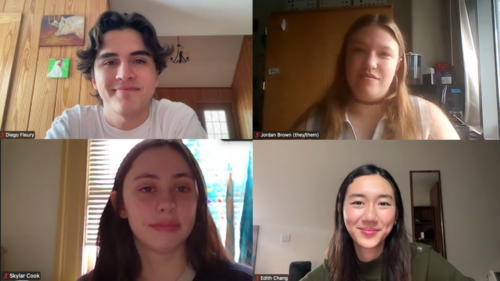
Jordan Brown, a senior studying gender studies and sociology at UCLA, had a similar surprise when they searched for their topic, Casa Xochiquetzal, on Wikipedia: “I was like, okay, this has to have a Wikipedia page because I just read a full 40-page chapter on this and I was really surprised to see that it wasn’t.”
In a similar vein, first year student at the University of New Hampshire Skylar Cook took the opportunity to improve an underdeveloped article on the Oʻahu ʻelepaio, a bird endemic to Hawaii. Before Cook’s contributions, the Oʻahu ʻelepaio article only offered a couple of unsourced paragraphs.
A critical takeaway from these moments of surprise was succinctly put by Diego Fleury, first year graduate student studying physiology at North Carolina State University: “It was just a reminder that with the world always changing and evolving, there’s always space for new ideas and new topics to be discussed.”
Sharing their work
As Wikipedia is a publicly-accessible resource, our panelists all noted their excitement to share their work with people dear to them.
Beyond readership, Fleury explained how the inspiration for creating the article on Estrobolome was in part due to his mom’s interest in microbiology: “I actually came up [with the topic] in a brainstorming session with my mom.” (Read more about Fleury’s experience here.)
Knowing that their Wikipedia contribution would be shared with family and friends, it served as motivation to hone their critical thinking and writing skills in order to create accurate and accessible information.
“You want to make sure it’s super accurate, it makes sense, and it’s accessible so it’s a great way for me to digest what I am reading and then be able to convey that and then share it with my friends and family,” said Chang.
Appreciation for the Wikipedia community
Debunking the long standing misconception of Wikipedia’s unreliability, Fleury explained his experience learning about the knowledge creation process on Wikipedia:
“You’d be surprised with how strict and how much scrutiny Wikipedia articles go through because you hear all the time ‘Oh Wikipedia, anybody can edit it, anybody can change it and you can just say whatever,’ which… Yes, technically anybody can change it, but there’s a very stringent process by which articles are basically looked over by tons and tons of people.”
Along a similar thread, Cook expressed her gratitude for Wikipedia’s knowledge creation ecosystem and the volunteers that keep it running behind the scenes.
“What I took away from this was an appreciation for the volunteers and the people that edit Wikipedia, because all this work is really important, and to see how so many people have edited Wikipedia before us, and we never really even think about it, and how much work they put in, and how much of an impact they always make,” said Cook. “That’s just a really important thing that I want to take with me, so that in my future, I can always look to make an impact as well.”
Join our next Speaker Series webinar tomorrow, March 10!
Trying Something New: Faculty reflect on first time teaching with Wikipedia
Tuesday, March 10, 2026
10 am Pacific / 1 pm Eastern
Registration
Interested in incorporating a Wikipedia assignment into your course? Visit teach.wikiedu.org to learn more about the free resources, digital tools, and staff support that Wiki Education offers to postsecondary instructors in the United States and Canada.
Interested in learning how to add your expertise to Wikipedia? Explore Wiki Education’s upcoming courses for subject-area experts.