As one of the most famous figures of the American Revolution, it’s no surprise that Paul Revere’s English Wikipedia article has existed for nearly as long as the online encyclopedia itself.
More surprising? Even after nearly 2,500 edits throughout more than 20 years, and with over 400 editors watching the page, there are still missing pieces to fill in the midnight rider’s history. And who is uniquely positioned to spot and fill these gaps? Historian Tegan Kehoe at the Paul Revere House in Boston, for one.
Kehoe is just one of the 152 historians, museum curators, historical site professionals, and other history practitioners who have brought their collections and expertise to Wikipedia through Wiki Education’s new series of editing courses, launched in collaboration with American Association for State and Local History (AASLH).
To date, the courses have brought together experts from 47 states across the U.S. to improve Wikipedia’s coverage of their local history in celebration of the country’s upcoming 250th birthday this year.
Last month, Kehoe joined Sarah Rafael García (LibroMobile Arts Cooperative & Bookstore), Becky Raines (Museum of Natural and Cultural History-University of Oregon), and Con Trumbull (Nevada Northern Railway) as the featured panelists of Wiki Education’s Speaker Series webinar, “When Experts Edit: Improving Wikipedia’s coverage of U.S. history,” moderated by Wiki Education’s Kelly Doyle Kim.
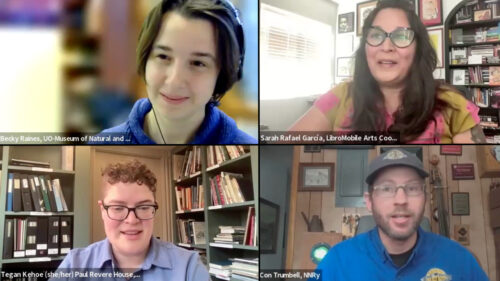
The panelists reflected on their personal experiences, noted systemic challenges in the work to improve open access knowledge through Wikipedia, and underscored both the local and global impact of the initiative.
“We have to talk about accessibility,” said García, a scholar and educator who has worked to expand Wikipedia’s coverage of Latinx communities and individuals. “A lot of information is not available at our fingertips if you don’t have a connection to a historical archive or an institution. [Wikipedia] is still accessible when you leave campus, it’s still accessible when you can’t get accepted to be part of an institution that has archives and paywalls.”
For museum professionals, improving Wikipedia often also enhances the way visitors engage with and understand their collections.
“We can’t put signs everywhere, so people go to their phones and pull things up right away,” explained Trumbull, archivist at the Nevada Northern Railway Museum. “Having a resource that’s very comprehensive like Wikipedia has changed the game immensely for all of us.” (Read more about Trumbull’s experience.)
Panelist Raines also contrasted the physical constraints of museum exhibits, where space is limited and content must be accessible to a wide range of visitors, with the more expansive possibilities of adding information and sources to Wikipedia.
The Oregon-based museum professional enrolled in the Wiki Education editing course expecting to struggle to find something to work on, but quickly realized she shouldn’t have worried — there were plenty of gaps to fill using her knowledge of Indigenous populations of the Pacific Northwest.
“I’m finding that a shocking number of contemporary Indigenous people are not represented at all on Wikipedia,” explained Raines. “Once those articles are written, people are jumping in, people are adding to them, fleshing them out. But the initial step of [creating] those articles has been lacking.”
Thanks to Raines, Wikipedia now includes articles about notable but lesser-known Pacific Northwest figures like artist and writer Carla Rossi and multimedia artist Steph Littlebird.
Across the country at the Paul Revere House, Kehoe reflected on how Wikipedia aligns naturally with the goals of public history, not only reaching broader audiences, but helping the public better understand how sources are evaluated and knowledge is created.
“Those of us who work in public history [are] already trying to connect with the public,” explained Kehoe. “Wikipedia is a really great tool for broadening our reach. And teaching people how to edit Wikipedia is a really amazing way to teach people about the process of history and the process of scholarship overall.”
And that sense of possibility certainly resonated beyond the panelists themselves, with one audience member summing up the spirit of the conversation in the webinar chat box:
“Your enthusiasm and creativity gives me hope.”
Join our next Speaker Series webinar tomorrow, January 14!
Wikipedia at 25: Authority, Legitimacy, and the Future of Knowledge
Wednesday, January 14, 2026
9 am Pacific / 12 pm Eastern
Registration
Interested in learning how to add your expertise to Wikipedia? Explore Wiki Education’s upcoming courses for subject-area experts.

This article helped me appreciate the level of commitment Wiki Education brings to inquiring minds, whether their perspective is academic, general curiosity, or something in between. I appreciate this resource which you have been thoughtfully building!