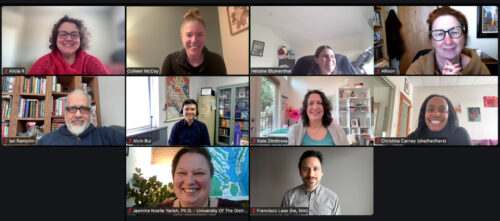
As we move forward in the third year of our Knowledge Equity initiative, Wiki Education is proud to announce the seven educators who will serve on the 2026 Humanities & Social Justice Advisory Committee. Representing a range of higher education institutions, humanities disciplines, and approaches to public scholarship, these faculty members share a commitment to expanding representation, improving access to reliable information, and helping students see their academic work as part of a broader knowledge ecosystem.
The committee will advise and support Wiki Education’s efforts to enhance Wikipedia’s coverage of historically underrepresented subjects through Wikipedia assignments, building on the outreach, communications, and publications work of the previous committees.
For Jasmine Yarish at the University of the District of Columbia, the committee role offers a chance to collaborate and connect with peers who share a commitment to public-facing scholarship.
“As a scholar grounded in interdisciplinarity as well as digital, historical, and cultural literacy, I wanted to join this committee to build solidarity across like-minded scholars who want to do the work to scale the walls of the academy and reach out to the public with accessible and responsible information,” said Yarish.
Yarish is particularly energized by the way Wikipedia challenges traditional academic roles.
“I am excited by the challenge of learning a new skillset that falls outside of the typical dichotomy of being either a knowledge consumer or knowledge producer,” explained Yarish. “Wikipedia provides a template and methodology for knowledge facilitation, where expertise and novel enthusiasm come together in an open access platform dedicated to ethical information gathering and collective learning. I like to think of it as a space that incubates innovation.”
Like Yarish, committee member Francisco Laso of Western Washington University brings a classroom perspective shaped by centering voices often missing from traditional narratives.
“I wanted to join Wiki Education’s Humanities and Social Justice Committee because my course with the Wikipedia assignment centers authors and perspectives from the Global South that most of my students have never encountered,” said Laso. “This exposure can be genuinely transformative — students regularly tell me that engaging with these voices is shaping what they want to do after graduation.”
Laso sees his role on the committee as a way to extend that impact beyond his own students.
“Wikipedia holds a special place for me — it’s one of the most democratic spaces on the internet — and having students contribute to it has proven to be among the most intellectually rigorous and personally meaningful assignments I’ve ever taught,” said Laso. “What excites me about this committee role is working ‘behind the scenes’ to help other educators build similar experiences in their own classrooms, so that the impact scales far beyond my own courses.”
Laso, Yarish, and their fellow committee members will engage in Wiki Education’s outreach and recruitment activities, conference participation, and publication projects throughout the year. We are grateful to all seven members for their service and leadership.
2026 Humanities & Social Justice Advisory Committee members:
Christina Carney
Dr. Christina Carney is an Associate Professor of Black (Queer) Sexuality Studies at the University of Missouri (Columbia) and has taught with Wiki Education since 2018. She is the author of Disreputable Women: Black Sex Economies and the Making of San Diego (2025). Her research interests include Black Feminism, Sex Work and Sex Economies, Urban Studies and the African Diaspora. While Carney’s first book examined how the sexual policing of Black women sex workers was foundational to the city of San Diego’s development as a center of tourism and the military, her current project takes a more global and transhistorical approach by examining how heritage tourism in Brazil engenders new sex economies and forms of relationality in the African Diaspora. Her work has been supported by the Institute for Citizens and Scholars (formerly the Woodrow Wilson Fellowship Foundation) and the US Fulbright Scholars Program. Carney also serves on the editorial board for African and Black Diaspora: An International Journal.
Kate Dimitrova
Since 2019, Dr. Kate Dimitrova has been teaching classes on Medieval Art, the European Renaissance, and Medieval Islamic Art at the University of San Diego; before that she served as Assistant Professor and then Associate Professor at Alfred University in New York. She also worked at the Metropolitan Museum of Art in New York and then the J. Paul Getty Research Institute in Los Angeles. Her publications include a co-edited book with Margaret Goehring, Dressing the Part: Textiles as Propaganda in the Middle Ages (Brepols, 2014) and a forthcoming Festschrift in honor of Alison Stones. Her research has been supported by a Fulbright Fellowship in Brussels and a Kress Fellowship at the Institut national d’histoire de l’art in Paris. In 2022, Dr. Dimitrova launched the Wikipedia assignment working alongside her first-year students for an introductory survey course, “The Year 1500: A Global History of Art & Architecture” that explores the complex global connections and relationships that intertwined Europe with Asia, Africa, and the Americas during this so-called “Age of Exploration.” In addition, she has participated in the Wiki Education Scholars Program and has presented at several conferences to encourage other faculty members to embrace the Wikipedia assignment that transforms students to become both content creators and facilitators in knowledge sharing – activities that are meaningful far beyond the walls of the classroom.
Alvin Khiêm Bùi
Dr. Alvin Khiêm Bùi is Assistant Professor of History of Asian Peoples in Diaspora at Brooklyn College, City University of New York. He was a Visiting Research Fellow for the US-Vietnam Research Center at the University of Oregon’s Global Studies Institute. He is a proud product of public education and uses that education in public service, having earned his doctoral degree from the University of Washington, Seattle in modern Southeast Asian and East Asian history. During his time at UW, he served as Project Coordinator for the Washington State Racial Restrictive Covenants Project, mapping neighborhoods covered by racist deed provisions and restrictive covenants. He graduated Phi Beta Kappa and magna cum laude from UCLA in History and Asian American Studies, after which he lived and worked in Vietnam in education and venture capital. He has published on Saigonese motorbike YouTubers and their diasporic Vietnamese audiences in Asiascape: Digital Asia.
Francisco J. Laso
Dr. Francisco Laso is an Assistant Professor of Geography and Environmental Studies at Western Washington University. His research and teaching sit at the intersection of Geographic Information Systems (GIS), political ecology, and community-engaged scholarship, with long-term collaborations in Ecuador and the Galápagos Islands focused on land use, agriculture, and environmental justice. Across his work, Francisco examines how environmental knowledge is produced, represented, and made accessible—and whose perspectives are amplified or overlooked in that process. His research, informed by fieldwork supported by international conservation organizations including the World Wildlife Fund, brings together qualitative and spatial approaches to make underrepresented environmental perspectives legible within dominant public and academic knowledge spaces. In the classroom, he designs public-facing, transnational learning experiences that connect students across regions and epistemic traditions, including courses such as Extractivism and Its Alternatives in Latin America, which incorporate Collaborative Online International Learning (COIL) partnerships with students in Ecuador and culminate in Wikipedia contributions requiring careful attention to sourcing, neutrality, and representation. He is also the founder of the Mapping Accessibility Project (MAP), which engages students in collaborative GIS work to document accessibility barriers and improve access to spatial information.
Allison Marsh
Dr. Allison Marsh is a public historian of technology with research interests on women in electrical engineering. During the spring of 2025 while on sabbatical, Allison enrolled in the 250 by 2026 Wiki Education course to help cultural heritage organizations build their Wikipedia presence in advance of the nation’s semiquincentennial. As part of the course, she drafted her first Wikipedia article, a biography of engineering rockstar Mabel MacFerran Rockwell. Her experience converted her to a Wikipedia evangelist. She incorporated writing Wikipedia articles in her fall courses and again in the spring. So far her students have created 39 new articles on notable women in South Carolina and added 54k words. Allison suspects the Wikipedia assignment will become a staple in all future courses. She is giving her first public talk on “Teaching with Wikipedia” on 3 February 2026 at the Loblolly Society. Allison is an Associate Professor of Women’s & Gender Studies and the Co-Director of the Ann Johnson Institute for STS at the University of South Carolina.
Alicia Rita Rueda-Acedo
Dr. Alicia Rita Rueda-Acedo is an Associate Professor of Spanish Literature, Translation, and Interpreting at The University of Texas at Arlington, where she founded and directs the Spanish Community Translation and Interpreting Program. Her work centers on connecting academic study with community engagement, and she has received multiple teaching awards, including the 2023 Example of Excelencia in Education. She is the author of Miradas transatlánticas: el periodismo literario de Elena Poniatowska y Rosa Montero (2012) and Miradas y aperturas: el artículo de opinión en el periodismo literario de Poniatowska, Mastretta y Luiselli (2024), and the co-author of Independencias, Revoluciones y Revelaciones: doscientos años de literatura mexicana (2010) and Fostering Inclusion Across Countries Through Community Translation and Interpreting (2026). She has published numerous book chapters and articles on 20th- and 21st-century Transatlantic literature from Mexico and Spain, addressing topics such as literary journalism and women authors in leading journals in the field. Dr. Rueda-Acedo integrates community translation, experiential learning, interprofessional education, and service-learning into her teaching by partnering with non-profit organizations to provide language access for underserved communities. Since 2025, she has also integrated Wikipedia assignments into her courses, leading translations of articles on rare diseases and U.S. immigration law into Spanish, as well as articles on Hispanic women writers into English.
Jasmine Noelle Yarish
Jasmine Noelle Yarish (Dr. JNY) is an Assistant Professor of Political Science at the University of the District of Columbia (UDC). As a political theorist and archival methodologist, she teaches core courses for the political science B.A. as well as civics and ethics courses for the interdisciplinary general education (IGED) program and the U.S. history sequence integrating digital literacy skills from LinkedIn to Wikipedia. Before joining UDC in the fall of 2020, she held visiting assistant professorships at Hobart and William Smith Colleges and Augustana College. A first-generation scholar raised in the Appalachian hills of central Pennsylvania, she specializes in the intersections of race, gender, sexuality, spatiality, material culture, and democratic theory. Since completing a Ph.D. with certificates in Black Studies and Global Studies at the University of California, Santa Barbara, her scholarship extends the idea of abolition democracy theorized by W.E.B. Du Bois to include political and intellectual contributions made by black women in and around the city of Philadelphia during the era of Reconstruction in the mid to late nineteenth century. With multiple publications in peer-reviewed journals and edited volumes, as well as supporting archival efforts for public history projects in the City of Philadelphia, namely the Ben Fletcher mural and I.W.W. Local 8 historical marker, Dr. JNY’s scholarship is placed prominently in the growing literature on the “Third Reconstruction,” racial capitalism, and abolition democracy.