Twenty-five years ago, Wikipedia launched with the ambitious idea that people around the world could collaboratively create the sum total of human knowledge.
What began as a bold experiment has since become a cornerstone of the modern information ecosystem, shaping how billions of people learn, teach, and make decisions every day. Last month, Wiki Education marked the free encyclopedia’s milestone birthday with a special Speaker Series webinar grounded by one foundational question:
What has Wikipedia taught us about knowledge over the past quarter century — and what comes next?
The anniversary discussion gathered scholars Phoebe Ayers (Massachusetts Institute of Technology), Carwil Bjork-James (Vanderbilt University), Ryan McGrady (University of Massachusetts Amherst), and Steven Mintz (University of Texas at Austin), who brought a combined 60+ years of Wikipedia experience to reflect on Wikipedia’s growth, evolution, and future.
“Early on, [Wikipedia] felt much more like an experiment,” said Ayers, who has edited Wikipedia for more than two decades. “Today, when you’re contributing, you know that Wikipedia is an institution. It matters, and people are going to read this thing. The sense that we have a responsibility to get it right was true then, and it’s still true today.”
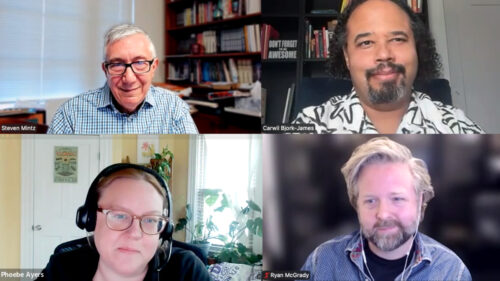
At the heart of Wikipedia’s success? A collective commitment to standards, sourcing, and the idea that knowledge improves through collective vetting over time, noted McGrady.
“Wikipedia’s legitimacy comes from a combination of its process and the intentions of its volunteers who are there to support the process,” said McGrady. “Over time, as the standards have evolved and become quite strict…the role of expertise shifted on Wikipedia from just ‘write what you know’ to becoming an expert in the selection and summary of the best possible sources.”
Like Ayers and McGrady, Bjork-James is a long-time Wikipedia editor, bringing his expertise as an anthropologist to his efforts to fill knowledge gaps and add underrepresented perspectives to Wikipedia articles. He has also taught with the Wikipedia assignment for the past ten years, and emphasized the joy of empowering his students to contribute to the encyclopedia, shifting them from knowledge consumers to producers.
“Teaching with Wikipedia gives people the opportunity to switch from being readers to creators on Wikipedia,” said Bjork-James. “That shift to authorship is a really powerful moment.”
The four panelists discussed Wikipedia’s ongoing challenges, including systemic gaps in coverage, misinformation, and the limitations of its secondary source policy when considering topics and groups underrepresented in traditional academic publishing.
While recognizing these challenges, Mintz continued to praise Wikipedia’s commitment to collaboration and transparency, an alternative to long-held assumptions about where expertise resides and how authority is earned.
“What you all have proven with Wikipedia is that intelligence is distributed,” said the history professor, speaking to his fellow panelists and other editors in attendance. “It is not confined to a small number of faculty offices, it’s widespread. Wikipedia is what the internet was supposed to be — not commodified knowledge for sale, but bringing the world together to pool all of our knowledge. It is more reliable because of procedure rather than prestige.”
Join our next Speaker Series webinar tomorrow, February 11!
Inside the Wikipedia Assignment: Student Perspectives
Wednesday, February 11, 2026
10:30 am Pacific / 1:30 pm Eastern
Registration
Interested in incorporating a Wikipedia assignment into your course? Visit teach.wikiedu.org to learn more about the free resources, digital tools, and staff support that Wiki Education offers to postsecondary instructors in the United States and Canada.
Interested in learning how to add your expertise to Wikipedia? Explore Wiki Education’s upcoming courses for subject-area experts.
I found this discussion about Wikipedia’s 25th anniversary very insightful. It’s amazing to see how collaborative efforts can improve knowledge and make information more accessible to everyone. I also appreciate the emphasis on teaching students to become creators, not just consumers, of knowledge.